Stock Analysis · Restaurant Brands International Inc (QSR)
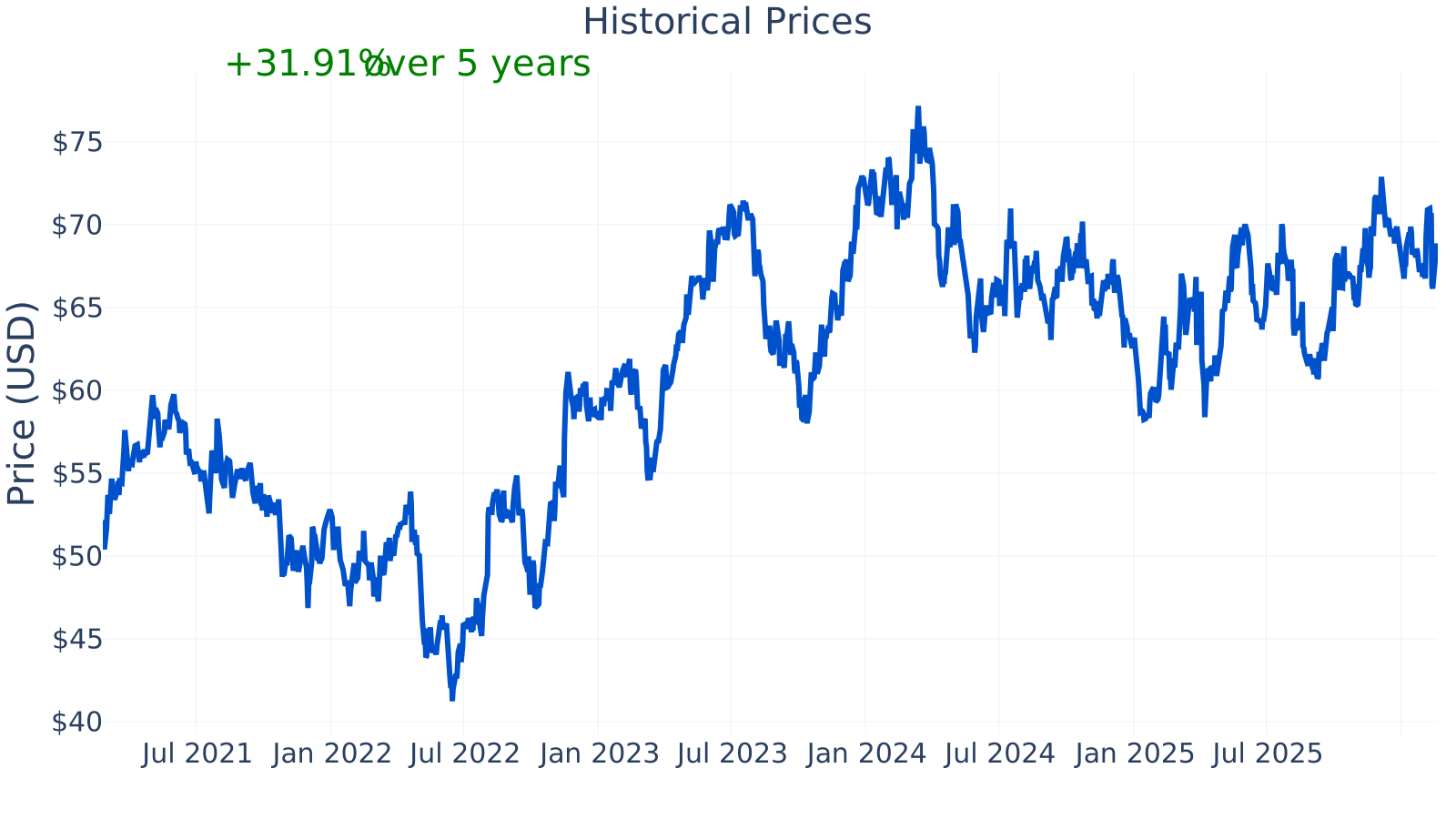
Overview
Restaurant Brands International Inc. (QSR) is a global quick-service restaurant (fast food) company that owns and franchises well-known brands, including Tim Hortons, Burger King, Popeyes, and Firehouse Subs. Its business model is largely built around franchising: many restaurants are owned and operated by franchisees, while the company provides the brand, marketing, menu standards, technology, and supply chain programs.
Because franchising is a central pillar, QSR’s economics are often different from a restaurant company that directly operates most locations. A franchisor typically earns revenue from ongoing royalties and fees tied to franchisee sales, plus other streams such as rental income (where the company controls certain real estate/leases), supply chain and distribution-related income, and sales from any company-operated restaurants (which tend to be a smaller portion for heavily franchised systems).
Across its disclosures, QSR commonly describes these main revenue “building blocks” (exact mix can change by segment and year):
- Royalties and franchise fees (ongoing payments typically linked to franchisee sales)
- Sales at company restaurants (where QSR directly operates locations)
- Rental income (in markets where QSR controls property or master leases)
- Supply chain and distribution-related revenue (where applicable by brand/region)
Scale and recent direction (high level): in the last several years, total revenue increased meaningfully, from about $5.7B (2021) to about $9.4B (2025). Over the same period, operating income remained sizable, while interest expense was also a material cost item—important context for a company that uses significant leverage.
From 2021 to 2025, revenue rose from $5.739B to $9.434B. Over that span, operating income stayed above $1.8B each year, while interest expense remained significant (hundreds of millions annually), highlighting how financing costs can influence net results even when restaurant-level demand is healthy.
Key Figures
| Metric | Value | Industry ⓘ |
|---|---|---|
| Date | Feb 23, 2026 | |
| Context | ||
| Sector | Consumer Cyclical | |
| Industry | Restaurants | |
| Market Cap ⓘ | $31.37B | |
| Beta ⓘ | 0.59 | |
| Fundamental | ||
| P/E Ratio ⓘ | 26.17 | 27.46 |
| Profit Margin ⓘ | 8.23% | 7.73% |
| Revenue Growth ⓘ | 7.40% | 7.35% |
| Debt to Equity ⓘ | 478.23% | 99.20% |
| PEG ⓘ | 1.16 | |
| Free Cash Flow ⓘ | $1.40B | |
QSR’s market capitalization is about $31.4B, placing it among the larger global restaurant groups. The stock’s beta of ~0.59 suggests it has historically moved less than the broader market on average (though that does not prevent drawdowns).
On profitability, the latest profit margin is ~8.2%, slightly above the restaurant industry median shown here (~7.7%). Revenue growth over the last year is about 7.4%, roughly in line with the industry median (~7.35%).
The most notable item in these metrics is leverage: QSR’s debt-to-equity is ~478%, far above the industry median displayed (~99%). This highlights a capital structure that can amplify results in good periods but can also increase sensitivity to interest rates, refinancing conditions, and business downturns.
Free cash flow over the last twelve months is about $1.40B, indicating meaningful cash generation after operating expenses and capital spending (a key consideration for a franchising-heavy model).
Growth (Medium)
The quick-service restaurant industry is mature in many developed markets, but it can still grow through a combination of new restaurant openings, international expansion, menu innovation, and higher average check (pricing and mix). For a global franchisor like QSR, growth is often driven less by building company-owned restaurants and more by expanding the franchise footprint and increasing system-wide sales (which then supports royalties and related income).
Strategically, QSR’s multi-brand structure can support growth by diversifying demand across different customer occasions (coffee and bakery at Tim Hortons, burgers at Burger King, chicken at Popeyes, and sandwiches at Firehouse Subs). In addition, franchising can enable expansion with less corporate capital tied up in each new unit, while still producing recurring fee streams.
The year-over-year revenue growth pattern shows stronger quarters at times (notably in parts of 2024) and more moderate growth more recently, ending around 7.4% in the most recent period shown. This profile fits a large consumer brand operator where growth can be steady but not uniform quarter to quarter.
Free cash flow has remained substantial over the period shown (roughly $0.94B to $1.59B across the displayed dates), with the latest around $1.40B. Consistent cash generation can be important for funding brand investment, technology, debt service, and shareholder returns, but the sustainability of that cash flow depends on franchisee health, consumer demand, and financing costs.
Risks (High)
Leverage and interest-rate sensitivity stand out as major considerations. A highly leveraged structure can leave net income more exposed to changes in borrowing costs and refinancing conditions. It can also reduce flexibility if results weaken or if capital markets tighten.
The debt-to-equity ratio remains very elevated versus the industry median throughout the period shown, ending around 478% compared with an industry median near 129% at the latest point on the chart. Even though the ratio has moved somewhat over time, it consistently signals that balance-sheet risk is higher than typical peers in the same industry grouping.
Profitability can fluctuate due to brand-level performance, marketing investment, inflation in labor and commodities (which can pressure franchisee economics and, indirectly, system health), and restructuring or one-time items that affect reported earnings.
Profit margin has trended down from much higher levels earlier in the period to about 8.2% most recently. While that is still slightly above the industry median shown (~7.7%), the direction matters: declining margins can reflect higher costs, higher interest burden flowing through the income statement, or other business pressures that may not be visible from revenue alone.
Brand execution risk is ongoing in fast food: customer traffic can shift quickly with changes in pricing, product quality, service speed, and consumer preferences. Competitive intensity is persistent, and advertising and promotions can compress profitability across the sector.
Franchise system health is another key risk for a franchisor. When franchisees face margin pressure (for example, from wage inflation or food costs), that can reduce their willingness or ability to remodel, expand, or maintain service levels—factors that can ultimately affect system sales and brand strength.
Competitive positioning and advantages: QSR’s main advantages are global brand recognition, scale (marketing, technology, and procurement), and a franchise-heavy model that can generate recurring royalties and fees. It is a major global player, but it is not the only scaled operator. Key competitors in quick-service include large global systems such as McDonald’s, Yum! Brands (KFC, Taco Bell, Pizza Hut), and Wendy’s, as well as strong regional coffee, chicken, and sandwich chains that compete brand-by-brand and market-by-market. Competitive position therefore depends heavily on execution within each brand and geography rather than on the corporate group alone.
Valuation
Valuation is often summarized through multiples like the price-to-earnings (P/E) ratio, which compares the stock price to the company’s earnings. A P/E can be more informative when paired with growth and risk: for example, higher leverage can raise risk, while steadier cash generation can support higher multiples. It’s also useful to compare with industry medians and with the company’s own history.
QSR’s latest P/E is about 26.2, slightly below the industry median shown (~27.5). Historically in the chart, QSR’s P/E has moved across a wide range (from the low-to-mid 20s up to the 30s and higher), sometimes trading above the industry median and at other times closer to it. This suggests the market’s valuation has been sensitive to shifts in expected growth, margin trends, and the impact of financing costs.
Given the combination of moderate revenue growth (recently ~7%), meaningful free cash flow (about $1.40B TTM), and high leverage (debt-to-equity near 478%), the current valuation level appears consistent with a large, established restaurant franchisor where growth is present but balance-sheet risk is a defining feature. Whether the valuation is “high” or “low” depends mainly on future brand performance, margin trajectory, and the path of interest expense over time.
Conclusion
Restaurant Brands International is a large global franchisor built around multiple well-known quick-service brands. The company has shown substantial revenue expansion over the last several years and generates significant free cash flow, which are important characteristics for a mature consumer business.
At the same time, the company’s financial profile includes clearly elevated leverage compared with industry norms, and profitability has trended downward from earlier highs to a level only modestly above the industry median shown. In practice, this means long-term outcomes may be driven as much by financing conditions and margin resilience as by top-line growth.
On valuation, the current P/E multiple is close to the industry median, implying a market view that is broadly in line with peers—balancing the benefits of brand scale and cash generation against competitive pressures and balance-sheet risk. Overall, the factual picture combines steady-industry characteristics and brand scale with a higher-than-typical leverage profile that can materially affect results across economic cycles.
Sources:
- SEC EDGAR — Restaurant Brands International Inc. filings (Form 10-K, Form 10-Q)
- Restaurant Brands International — Investor Relations materials (annual reports and investor presentations)
- Restaurant Brands International — Official press releases (Investor Relations)
- Wikipedia — “Restaurant Brands International” (basic company background)
This article is for informational purposes only and does not constitute financial advice. Some content is AI-generated. See Disclaimer


