Stock Analysis · POET Technologies Inc (POET)
Overview
POET Technologies Inc is a semiconductor-related company focused on optical interconnect technology. In simple terms, it works on ways to move data using light rather than only electricity, aiming to support faster and more energy-efficient connections inside data centers and other high-bandwidth systems. The company describes its approach as a platform intended to simplify how optical components can be integrated into products.
At the operating level, POET has been in an early commercialization stage, with revenue reported but at relatively small levels compared with operating costs in recent years. Based on its filings, its business model has been oriented around developing and commercializing its technology, which can translate into product revenue as adoption increases, but can also mean long periods where results are driven more by research, engineering, and scaling activities than by recurring sales.
Public filings show revenue has been modest and has varied significantly year to year, which is common for companies that are transitioning from development toward broader commercial deployment. Because detailed, stable revenue mix disclosures (with reliable percentages by product line or customer type) are not consistently available from the information provided here, the revenue sources can be described at a high level as:
- Early-stage product and technology-related revenue (reported revenue, but at small absolute levels in recent fiscal years)
- Other limited operating revenue streams (if any, typically not material relative to the company’s overall cost structure in recent periods)
The overall pattern shows very small annual revenue relative to operating expenses. Research and development and selling, general, and administrative costs have been large compared with gross profit, which has resulted in operating losses and net losses across the years displayed.
Key Figures
| Metric | Value | Industry ⓘ |
|---|---|---|
| Date | Mar 30, 2026 | |
| Context | ||
| Sector | Technology | |
| Industry | Semiconductors | |
| Market Cap ⓘ | $792.57M | |
| Beta ⓘ | 0.36 | |
| Fundamental | ||
| P/E Ratio ⓘ | N/A | 40.46 |
| Profit Margin ⓘ | N/A | 9.73% |
| Revenue Growth ⓘ | 7998.60% | 16.40% |
| Debt to Equity ⓘ | 10.96% | 23.21% |
| PEG ⓘ | N/A | |
| Free Cash Flow ⓘ | -$35.20M | |
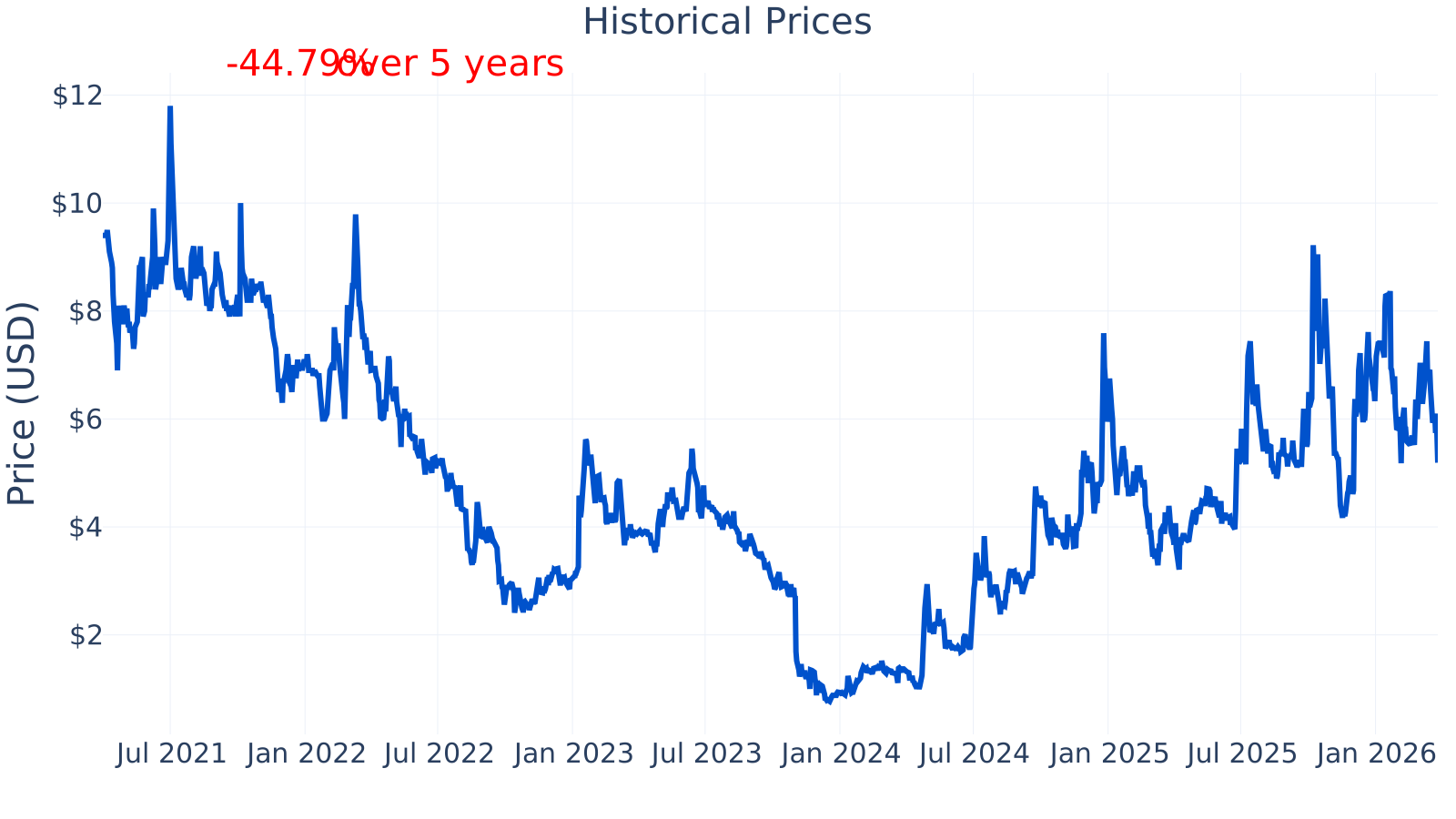
POET Technologies Inc’s market capitalization is about $793 million. The stock’s beta (~0.36) suggests lower correlation with broad market moves than many stocks, although beta may be less informative for smaller, volatile companies. The company’s profit margin is currently negative (shown as 0.0 in the summary table, while the history indicates substantial losses), compared with an industry median near 9.7%. Revenue growth is shown as elevated most recently (about +8,000% year over year), but that percentage can be heavily influenced by a very low prior-period revenue base. Debt-to-equity is about 11%, below the industry median near 23%. Free cash flow (TTM) is around -$35.2 million, indicating ongoing cash usage.
Growth (Medium)
POET operates in and around markets that benefit from long-term demand for more data throughput—especially where data centers and high-performance computing systems need faster connections with lower power consumption. Optical connectivity is commonly discussed in company materials as a way to address these demands, and the broader semiconductor ecosystem continues to focus on performance-per-watt improvements and higher bandwidth.
Strategically, POET’s stated direction—building a technology platform and moving toward commercialization—can make sense in an industry where customers value integration, manufacturability, and cost. However, the key question for long-term business growth is execution: whether the company can convert technical capability into repeatable, scaled production and durable customer demand.
Revenue growth has been highly volatile over time, including multiple periods of steep decline followed by extremely high growth rates. The most recent year-over-year revenue growth shown is very high (about +8,000%), which can happen when the starting point is close to zero. For long-term readers, the more meaningful confirmation typically comes from evidence of sustained revenue over multiple periods rather than a single spike.
Free cash flow has been consistently negative and has become more negative over the period shown (from roughly -$11.6 million to about -$35.1 million). This pattern suggests the company is still funding development and commercialization efforts with cash outflows, which often implies dependence on cash reserves and/or external financing until operations generate sufficient cash.
Potential catalysts (in a purely factual sense) generally include: clearer evidence of repeat customers, scaling manufacturing, improved gross profit, and operating expense discipline. These are typically the kinds of milestones that can change the business profile for early-stage semiconductor and optical-component companies.
Risks (High)
The primary risk is that the company has not yet demonstrated a stable, scaled, profitable operating model. The income statement pattern shown indicates operating expenses far exceed gross profit in the periods displayed. This raises the possibility of continued losses and continued funding needs if revenue does not scale meaningfully.
Debt-to-equity is currently around 11%, below the industry median near 23%. Lower leverage can reduce financial strain, but it does not remove the broader funding risk implied by ongoing negative free cash flow. If cash burn continues, funding may come from additional equity issuance, debt, or other financing structures, each of which can have trade-offs for shareholders.
Profit margins have been deeply negative across the history shown, while the industry median remains positive (generally in the high single digits to mid-teens earlier in the period, drifting lower more recently). Negative margins at this scale usually indicate that revenue is not yet sufficient to cover the cost structure, and that the company remains in an investment-heavy phase.
Competitive dynamics are another major risk. POET operates in a space with many capable, well-capitalized semiconductor and optical-component companies. Competitors may include large optical transceiver and photonics ecosystem players and integrated semiconductor vendors that can invest heavily in R&D, manufacturing scale, and customer relationships. In such markets, competitive advantages typically come from demonstrably better performance, cost, manufacturability, reliability, intellectual property, and the ability to deliver at scale. Based on the financial profile shown (very small revenue and ongoing losses), POET does not appear to be a proven market leader by scale; its differentiation, if any, would need to be validated through sustained commercial traction disclosed in filings.
Additional risks common to this type of company include customer concentration (a small number of early customers can dominate results), long sales cycles, qualification requirements, manufacturing ramp challenges, supply chain dependencies, and the possibility that the industry adopts alternative technical approaches.
Valuation
A traditional price-to-earnings (P/E) ratio is not meaningful here because the company has reported losses over the period shown (the P/E series is displayed as 0 in the history provided, which commonly occurs when earnings are negative and P/E is not interpretable). The industry median P/E shown is around 40, but that comparison is not directly applicable when a company is not profitable.
In cases like this, market value tends to reflect expectations about future commercialization rather than current earnings power. With a market capitalization around $793 million and continued negative free cash flow, the implied valuation depends heavily on whether revenue can scale and whether margins can improve toward sustainable profitability over time. Without stable, material revenue and without profits, valuation assessment is inherently more uncertain and more sensitive to execution milestones disclosed in official filings.
Conclusion
POET Technologies Inc is positioned in a technology area tied to rising data bandwidth needs, where optical solutions can play an important role. The company’s reported financial pattern, however, reflects an early-stage commercialization profile: very small revenue relative to operating expenses, negative margins, and negative free cash flow.
From a long-term fundamental perspective, the central issues to monitor are whether revenue becomes consistent and substantial, whether gross profit expands meaningfully, and whether cash usage moderates as the business scales. Until those elements are demonstrated in filings over multiple reporting periods, the company’s long-term profile remains dominated by execution risk, competitive pressure, and funding requirements rather than by established operating performance.
Sources:
- U.S. SEC EDGAR — POET Technologies Inc filings (Annual Report on Form 10-K; Quarterly Reports on Form 10-Q; Current Reports on Form 8-K)
- POET Technologies Inc — Investor Relations materials and press releases (company-hosted)
- Wikipedia — “POET Technologies” (basic company background)
This article is for informational purposes only and does not constitute financial advice. Some content is AI-generated. See Disclaimer


