Stock Analysis · Lightspeed Commerce Inc (LSPD)
Overview
Lightspeed Commerce Inc (LSPD) provides cloud-based software that helps small and mid-sized businesses run day-to-day operations. Its products are typically used by retailers and hospitality businesses (such as restaurants) to manage point-of-sale checkout, inventory, customer data, reporting, and—depending on the setup—online ordering and other “omnichannel” workflows. The company’s model is generally based on recurring software subscriptions and payments-related services that scale with a customer’s activity.
In plain terms, Lightspeed aims to be an operating system for merchants: the software helps run the business, and payments tools can process transactions. This combination can create a more “sticky” relationship because the merchant may rely on the platform for multiple critical functions.
Main revenue sources are commonly described in company filings as a mix of software subscriptions and transaction-based revenue tied to payments/merchant solutions. Public filings typically break revenue into a small number of broad categories (rather than a long list). Percentages by category can change over time and should be taken from the most recent annual report for precision.
- Transaction-based revenue (payments / merchant solutions): Revenue that tends to rise and fall with customer payment volume and usage of merchant services.
- Subscription revenue: Recurring fees for access to the software platform and modules.
- Other / services: Items such as implementation and professional services, depending on reporting definitions.
The simplified takeaway: part of Lightspeed’s revenue behaves like recurring subscriptions, while another part is tied to customer sales activity (which can be more cyclical).
Over the periods shown, total revenue increased substantially (from about $222M to about $1.08B), but operating expenses also remained high, and net income stayed negative. This pattern highlights a business that has scaled revenue while still working toward consistent profitability.
Key Figures
| Metric | Value | Industry ⓘ |
|---|---|---|
| Date | Feb 08, 2026 | |
| Context | ||
| Sector | Technology | |
| Industry | Software - Application | |
| Market Cap ⓘ | $1.27B | |
| Beta ⓘ | 2.18 | |
| Fundamental | ||
| P/E Ratio ⓘ | N/A | 27.79 |
| Profit Margin ⓘ | -58.15% | 6.02% |
| Revenue Growth ⓘ | 11.50% | 15.80% |
| Debt to Equity ⓘ | 1.35% | 25.15% |
| PEG ⓘ | N/A | |
| Free Cash Flow ⓘ | $30.88M | |
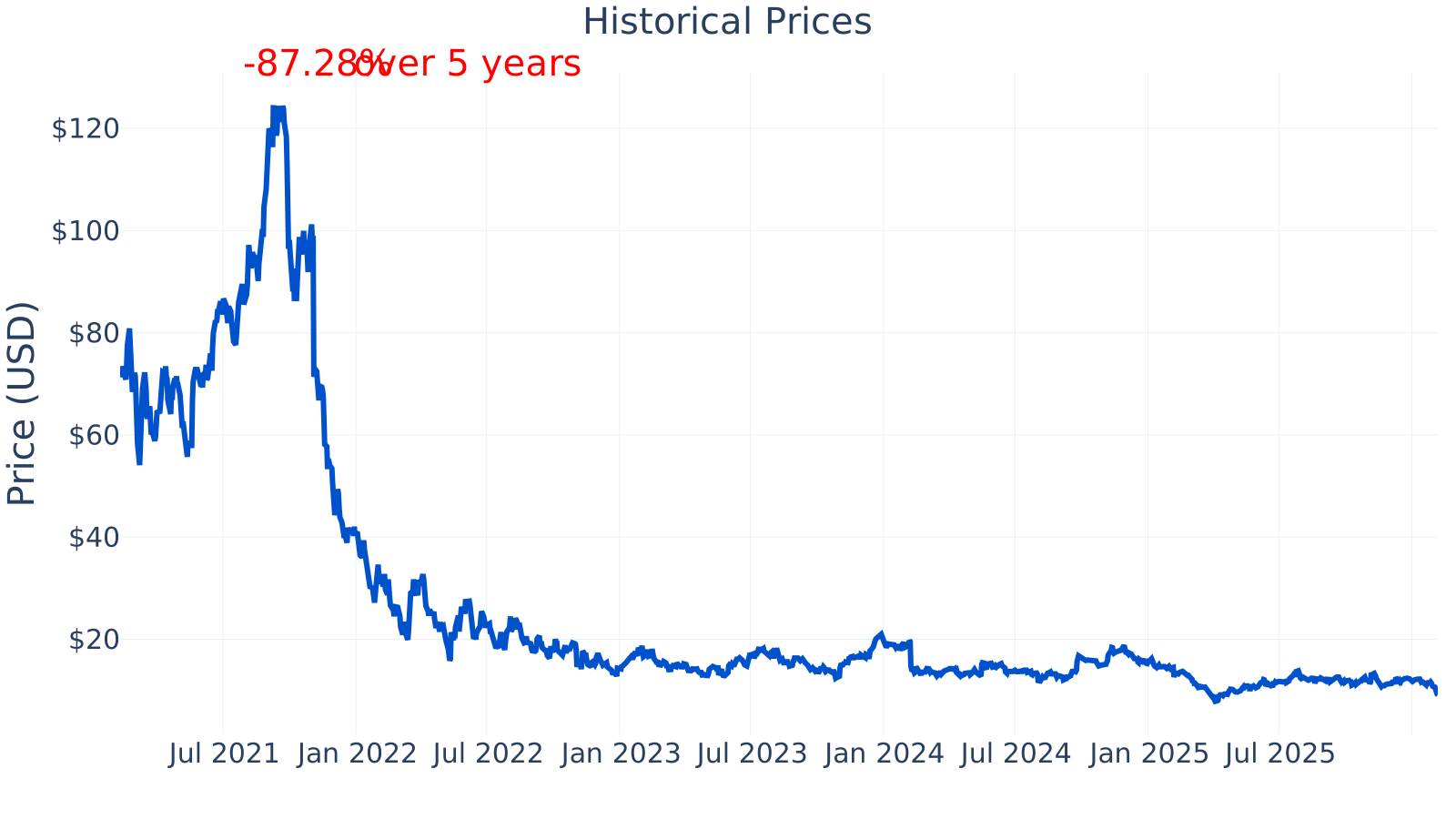
Recent snapshots show a market capitalization around $1.27B and a high beta (~2.18), which is another way of saying the stock has tended to move more than the broader market. Profitability remains a key gap: the latest profit margin shown is about -58% versus an industry median near +6%. Growth has moderated, with revenue growth around 11.5% year over year versus an industry median near 15.8%. Balance-sheet leverage looks low: debt-to-equity is about 1.3% versus an industry median around 25%. Free cash flow over the trailing twelve months is shown as +$30.9M, while the longer view below shows several years of negative trailing free cash flow, so readers typically look for confirmation that the shift is durable.
Growth (Medium)
Lightspeed operates in a segment of the software market focused on digitizing commerce for merchants—moving checkout, inventory, customer management, and analytics into cloud platforms. This broad direction has been supported by long-term trends such as merchants adopting cloud tools, expanding digital and in-store integration, and seeking more unified data across locations and channels.
That said, the growth profile shown has clearly cooled from very high rates earlier in the timeline to more moderate levels recently. This can happen as a company becomes larger, as comparisons get harder, and as the business shifts from expansion-at-all-costs toward efficiency and profitability.
The year-over-year revenue growth trend declines from extremely high rates earlier in the period to the low-to-mid teens more recently (about 11.5% at the latest point shown). For long-term context, this suggests Lightspeed’s future results may depend less on rapid top-line expansion and more on improving unit economics, retention, and monetization per customer.
Trailing free cash flow is negative for several years in the period shown and improves meaningfully by the most recent point (moving closer to break-even compared with earlier years). If this trajectory continues, it can reduce reliance on outside financing. If it reverses, it can reintroduce funding and dilution risk.
Potential catalysts (in a purely factual sense) typically include increased adoption of payments/merchant solutions within the customer base, improved efficiency in sales and marketing spend, and product expansion that increases revenue per customer. Execution matters because the same tools that can boost monetization (payments attach and add-ons) also face intense competition.
Risks (High)
The largest risk visible in the metrics is profitability. Despite revenue scaling, the profit margin remains deeply negative in the periods shown. Losses can reflect restructuring charges, non-cash items, and investment levels, but persistent negative margins still mean the business must keep improving operating discipline and gross margin structure over time.
The profit margin stays negative throughout the period and is far below the industry median in the latest reading (approximately -58% versus an industry median around +6%). Even though margins improved noticeably at points (for example, moving closer to break-even compared with earlier extreme negatives), the overall picture still shows a company that has not yet achieved consistent net profitability.
Another important risk is competition. Lightspeed sells into markets where switching costs exist (migrating POS systems, retraining staff, and moving data), but the space is crowded with well-funded providers. Competitors can bundle software and payments, compete aggressively on pricing, or use distribution advantages (large ecosystems, app marketplaces, hardware footprints). In retail and restaurants, competitive pressure can increase customer acquisition costs and limit pricing power.
Major competitors depend on the merchant segment and geography, but commonly include large commerce and POS/payment platforms (for example, Block/Square, Toast in restaurants, and Shopify in commerce enablement), along with other POS and merchant software vendors and regional providers. Compared to the largest platforms, Lightspeed is smaller by market value and scale, which can be a disadvantage in marketing reach and bargaining power, but it can also allow more focus in chosen verticals.
Industry cyclicality is also relevant. A portion of revenue is tied to customer transaction volumes, which can soften when consumer spending weakens. Small and mid-sized businesses can also be more sensitive to economic downturns.
Leverage appears low and stable across the period. The latest debt-to-equity is around 1.3%, well below the industry median near 25%. Lower leverage can reduce financial stress during volatile periods, although it does not remove the operational risk of sustaining losses.
Finally, the historical price path indicates substantial volatility, and the high beta aligns with that. Volatility itself is not a business risk, but it can reflect uncertainty around execution and profitability timelines.
Valuation
Traditional P/E (price-to-earnings) valuation is difficult to apply when net income is negative or highly variable due to non-cash charges. In those cases, the P/E can be undefined or not meaningful, and other approaches (such as revenue multiples, gross profit multiples, or cash-flow-based methods) are often used by analysts—though those require more assumptions.
The P/E series is not shown as meaningful for the company across the displayed period (values are effectively absent), which is consistent with losses and/or accounting effects that make earnings-based valuation hard to interpret. By contrast, the industry median P/E displayed remains positive and varies over time, reinforcing that many peers have more stable earnings profiles.
From a fundamentals-first perspective, valuation discussions for Lightspeed tend to revolve around whether operating losses narrow sustainably, whether free cash flow turns consistently positive, and whether revenue growth stabilizes at a level that supports the company’s cost structure. Because the stock has historically been volatile, market pricing can also shift quickly as expectations change, even without large changes in near-term revenue.
Conclusion
Lightspeed is a commerce software provider focused on helping merchants run retail and hospitality operations through cloud tools, with revenue that blends subscriptions and transaction-driven services. The business has scaled revenue significantly over the time shown and maintains low balance-sheet leverage relative to typical software peers.
The central open question is profitability: margins remain meaningfully negative and below the industry median, and the company’s long-term outcome depends heavily on turning revenue scale into durable earnings and cash generation. Growth has moderated into the low-to-mid teens recently, making operational efficiency and customer monetization increasingly important. Competitive intensity in POS, payments, and merchant software remains high, which can pressure pricing and customer acquisition economics.
Sources:
- SEC EDGAR — Lightspeed Commerce Inc filings (Annual Report / Form 40-F and interim reports)
- Lightspeed Commerce Inc — Investor Relations materials (financial results releases and shareholder/annual reports)
- Wikipedia — “Lightspeed Commerce” (basic company background)
This article is for informational purposes only and does not constitute financial advice. Some content is AI-generated. See Disclaimer


