Stock Analysis · Gildan Activewear Inc (GIL)
Overview
Gildan Activewear Inc. (GIL) is an apparel manufacturer focused on everyday basic clothing. The company designs, makes, and sells products such as t-shirts, fleece, underwear, and socks. A large part of its business is “blank” apparel that is later printed or embroidered by third parties for retail brands, events, schools, teams, and workplaces. Gildan’s model is built around large-scale manufacturing and distribution, aiming for low unit costs and consistent quality.
In general terms, Gildan’s revenue is mainly driven by high-volume basics sold through wholesale channels, with the rest coming from branded consumer products. In its reporting, the company typically organizes revenue around major product/reporting segments (commonly including areas such as Activewear and Hosiery & Underwear), and may also discuss performance by product category and geography in its annual report.
Over recent years, total revenue has been relatively stable in the low-to-mid single-digit billions, while profitability has moved more noticeably. For example, total revenue rose from about $2.92B (2021) to about $3.27B (2024), while net income fell from about $607M (2021) to about $401M (2024). The mix of costs also matters: interest expense increased substantially over the same period, which can weigh on net earnings even when operating income remains more resilient.
Key Figures
| Metric | Value | Industry ⓘ |
|---|---|---|
| Date | Mar 02, 2026 | |
| Context | ||
| Sector | Consumer Cyclical | |
| Industry | Apparel Manufacturing | |
| Market Cap ⓘ | $12.61B | |
| Beta ⓘ | 1.03 | |
| Fundamental | ||
| P/E Ratio ⓘ | 21.89 | 21.89 |
| Profit Margin ⓘ | 11.02% | 5.10% |
| Revenue Growth ⓘ | 31.30% | 1.60% |
| Debt to Equity ⓘ | 125.77% | 121.33% |
| PEG ⓘ | 0.67 | |
| Free Cash Flow ⓘ | $372.22M | |
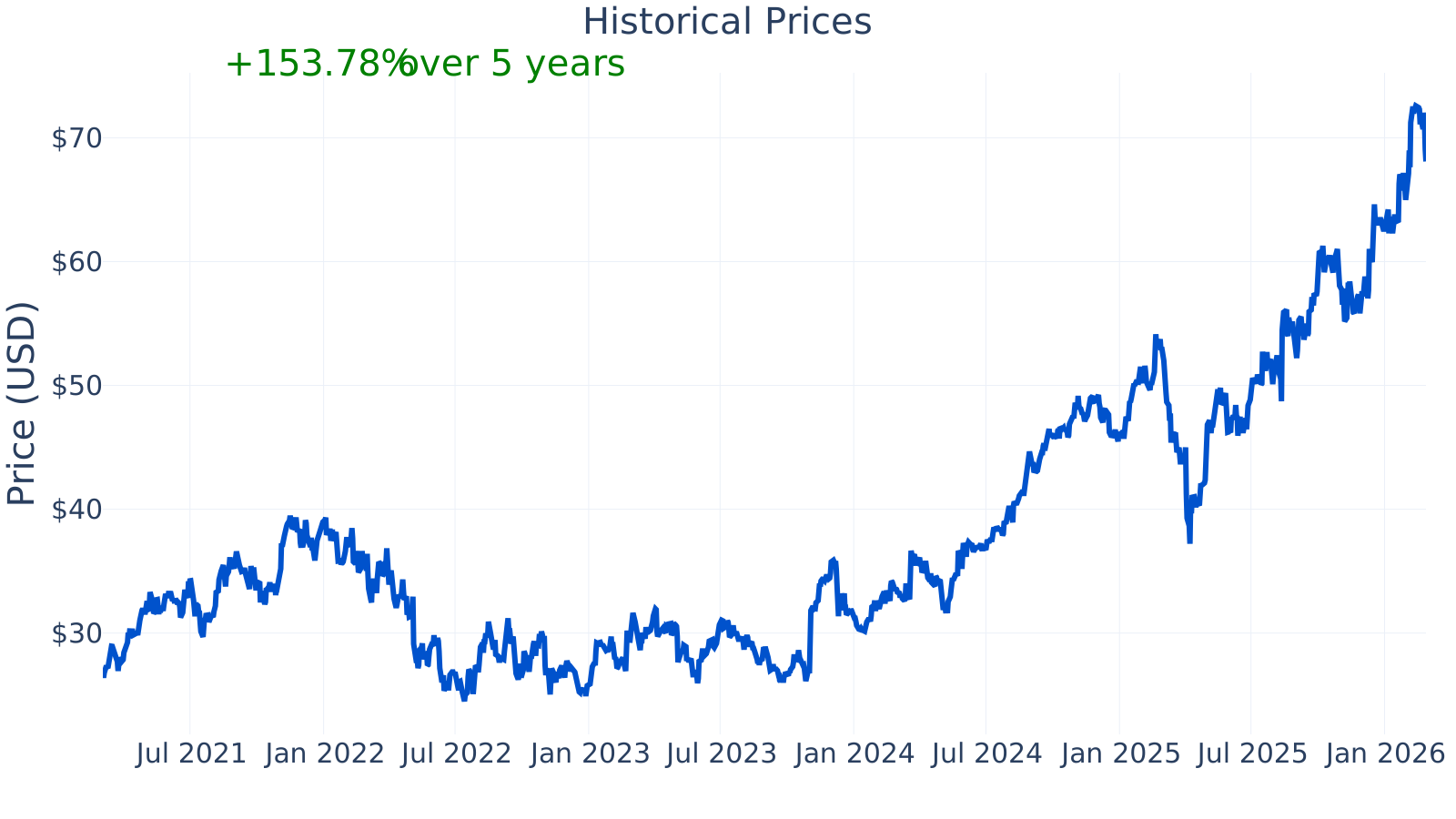
Gildan’s market capitalization is about $12.6B, and the stock’s beta is ~1.03, which is close to the broader market’s typical day-to-day volatility. The price-to-earnings (P/E) ratio is ~21.9, in line with the industry median shown here. Profit margin is about 11.0%, which is notably higher than the industry median (about 5.1%), suggesting stronger profitability than many peers at this point in time. Year-over-year revenue growth is shown at about 31.3% versus an industry median near 1.6%, which stands out as unusually high relative to typical apparel manufacturing growth rates. Debt-to-equity is about 126%, slightly above the industry median (~121%), which indicates meaningful use of borrowing relative to shareholder equity. Free cash flow over the trailing twelve months is about $372M.
Growth (Medium)
Apparel manufacturing is generally a mature, competitive industry. Demand tends to track population, employment, and consumer spending rather than long-term structural hypergrowth. That said, “basic” apparel can be more stable than highly trend-driven fashion because replenishment demand (replacing everyday items) continues in most economic environments. In addition, the market for blank apparel used in printing and promotional channels can benefit from small business activity, events, and corporate purchasing cycles.
Revenue growth has been uneven over the past few years, including periods of decline and periods of modest growth. The latest year-over-year growth shown (31.3%) is much higher than the recent quarterly pattern visible in the timeline, where many observations cluster in low single digits (and some are negative). When a single period shows a sharp jump, it is often worth checking in official filings what drove it (for example: pricing changes, volume recovery, product mix, foreign exchange, or timing effects).
Free cash flow has also been volatile. It was very strong in 2021 (~$617M), fell in 2022 (~$436M), dropped close to break-even in 2023 (~$1.1M), then rebounded in 2024 (~$521M) before declining again by 2025 (~$260M). For a manufacturing business, free cash flow can swing with inventory levels, capital spending, input costs, and working capital needs. A sustained ability to generate cash over a full cycle is often more informative than a single strong or weak year.
Potential long-term catalysts typically discussed for companies like Gildan include scaling efficient manufacturing, improving product mix toward higher-margin categories, expanding distribution relationships, and disciplined capital allocation. Confirmation of these drivers generally comes from multi-year consistency in margins, cash generation, and balance sheet stability rather than one-time improvements.
Risks (Medium-High)
Gildan’s results are sensitive to input costs and supply chain execution. As a large-scale apparel manufacturer, it faces risks from changes in cotton and other raw material prices, energy and transportation costs, and shifting labor and production conditions. Demand can also soften when consumer spending weakens, and wholesale customers may reduce orders or work down inventories, which can create uneven revenue patterns.
Leverage is an important consideration. Debt-to-equity has increased significantly over time, moving from roughly 36%–66% in 2021–2023 to above 100% in late 2024 and 2025 (recently around 126%). Higher leverage can amplify outcomes: it may help returns when business conditions are favorable, but it can also reduce flexibility during downturns and make earnings more sensitive to interest expense.
Profitability has generally been above the industry median for most of the period shown, which points to operational strengths, scale benefits, and/or product mix advantages. However, the company’s profit margin has also come down from peak levels (near ~20% in 2021–2022) to the low-to-mid teens more recently (around ~14% in the latest point), meaning the business is not immune to cost pressure or demand normalization.
Competitive positioning in apparel manufacturing is challenging because products can be commoditized and customers can be price-sensitive. Competitive advantages in this space often come from scale, reliable delivery, cost control, manufacturing know-how, and long-standing customer relationships. Gildan is commonly described (in company materials) as a large participant in basic/blank apparel, where scale and efficiency can matter more than fast-changing fashion trends.
Main competitors typically include other global apparel manufacturers and marketers in basics, underwear/hosiery, and blank apparel channels. Competitive pressure can show up as price competition, shifting retailer/wholesaler relationships, and changing consumer preferences. The most practical way to track whether Gildan is strengthening or weakening versus competitors is to watch relative margin trends, revenue stability through cycles, and cash generation in official filings.
Valuation
The P/E ratio has varied meaningfully over time, rising from single digits in 2022–2023 to the high teens more recently. The latest P/E shown is about 21.9, which is close to the industry median in the same snapshot. A higher P/E generally implies the market is pricing in either improved earnings durability, better growth expectations, or reduced perceived risk versus earlier periods.
Because the company’s margins and free cash flow can move up and down with costs, inventories, and demand cycles, a single-point valuation metric like P/E is best interpreted alongside profitability and leverage. In the latest metrics, Gildan shows a higher profit margin than the industry median, but also a higher debt-to-equity level than in prior years. The combination suggests a business that currently looks operationally stronger than many peers on margins, while carrying a balance sheet profile that may require closer attention.
Conclusion
Gildan Activewear is a large-scale manufacturer of basic apparel, with a business model that tends to rely on cost efficiency, consistent quality, and high-volume distribution channels. The company has recently shown profit margins above the industry median, which can indicate operating strengths in a competitive and often commoditized category.
At the same time, the picture is mixed across the broader set of fundamentals: revenue growth has been uneven over multiple periods, free cash flow has been notably volatile, and leverage has increased compared with earlier years. Valuation, based on the P/E ratio shown, currently sits around the industry median, which implies the market is not pricing the company as an outlier versus peers on that single measure.
For a long-term view, the most decision-relevant areas to follow in official filings are whether margins remain structurally higher than peers through different cost environments, whether free cash flow becomes more consistent over a cycle, and whether leverage stabilizes or declines in a way that improves financial flexibility.
Sources:
- SEC EDGAR — Gildan Activewear Inc. annual reports (Form 10-K) and quarterly reports (Form 10-Q)
- Gildan Activewear Inc. Investor Relations — Annual Report and regulatory filings (company-hosted)
- Wikipedia — “Gildan Activewear” (basic company background)
This article is for informational purposes only and does not constitute financial advice. Some content is AI-generated. See Disclaimer