Stock Analysis · Gildan Activewear Inc (GIL)
Overview
Gildan Activewear Inc. (GIL) is an apparel manufacturer focused on everyday basic clothing. Its products include items like T-shirts, fleece, underwear, socks, and other “activewear” basics. A large part of its business is selling blank apparel that is later printed or decorated by customers (for example, for teamwear, events, workwear, and branded merchandise), alongside products sold under its own consumer brands.
Operationally, Gildan is known for a vertically integrated model (it controls multiple steps of production, from yarn and fabric to sewing and distribution). This approach aims to support large-scale output, consistent quality, and cost control—important factors in basic apparel where pricing and reliability often matter as much as design.
Main sources of revenue are typically described through product categories and sales channels/regions in the company’s annual reporting. In general terms, Gildan’s revenue is driven by:
- Activewear (blank apparel): basics sold for printing/decorating (often the largest contributor)
- Hosiery & underwear: underwear and socks sold under company brands and private-label relationships
- Other: smaller categories and ancillary items
The exact mix and percentage breakdown can change year to year depending on demand cycles, inventory patterns at wholesalers/retailers, and pricing/inputs.
Across the years shown, total revenue trends upward overall (from about $2.92B in 2021 to about $3.27B in 2024). Over the same period, costs and operating expenses fluctuate, and net income declines (from about $607M in 2021 to about $401M in 2024), indicating that profitability has been pressured even while sales held up.
Key Figures
| Metric | Value | Industry ⓘ |
|---|---|---|
| Date | Feb 07, 2026 | |
| Context | ||
| Sector | Consumer Cyclical | |
| Industry | Apparel Manufacturing | |
| Market Cap ⓘ | $13.19B | |
| Beta ⓘ | 1.03 | |
| Fundamental | ||
| P/E Ratio ⓘ | 22.90 | 22.80 |
| Profit Margin ⓘ | 14.13% | 4.94% |
| Revenue Growth ⓘ | 2.20% | 1.60% |
| Debt to Equity ⓘ | 125.77% | 99.72% |
| PEG ⓘ | 0.66 | |
| Free Cash Flow ⓘ | $372.22M | |
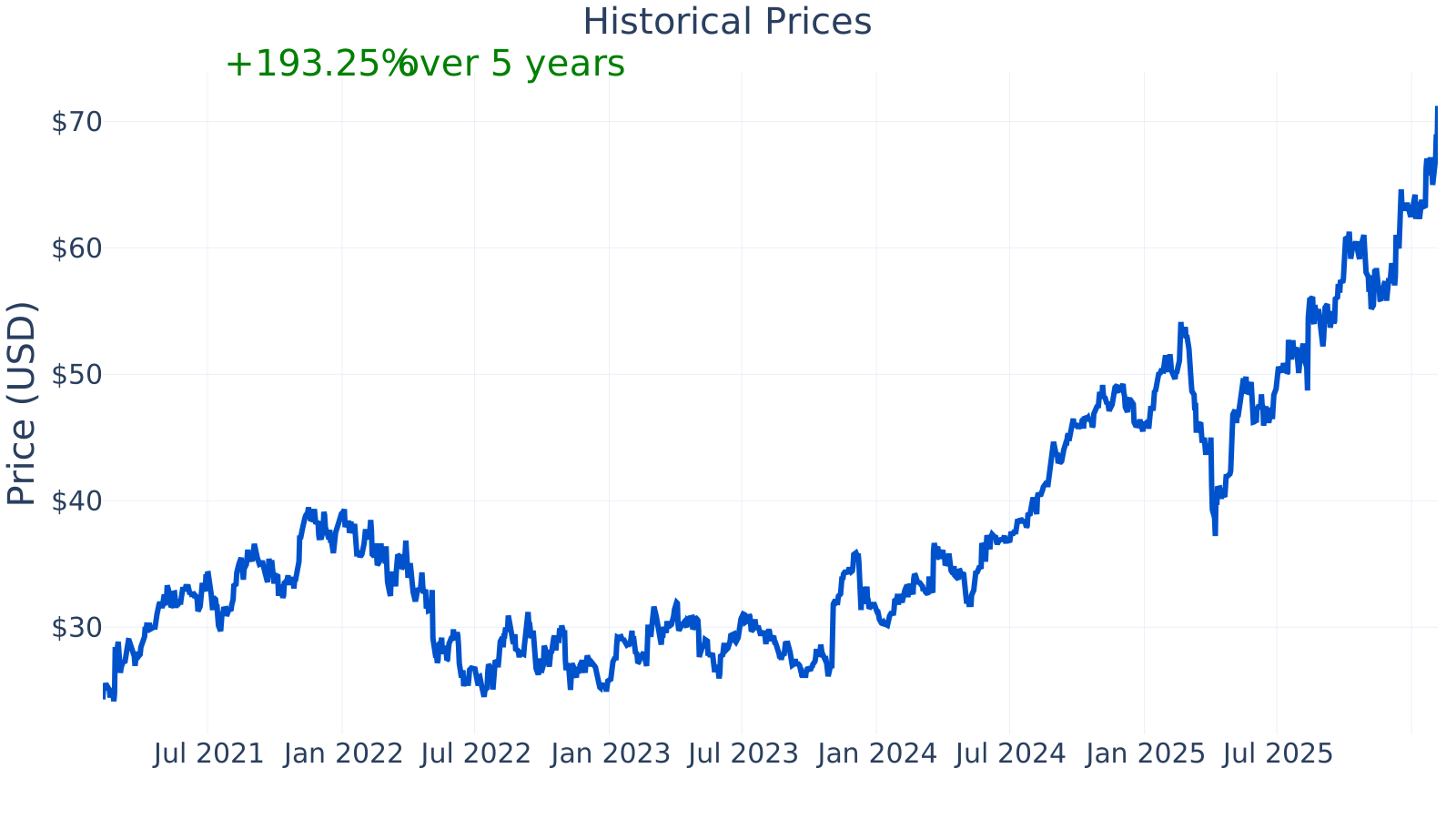
Gildan’s market capitalization is about $13.2B. The stock’s beta (~1.03) suggests price moves have been broadly similar to the overall market on average. The company’s P/E ratio (~22.9) is close to the industry median (~22.8), while its profit margin (~14.1%) is notably higher than the industry median (~4.9%). Year-over-year revenue growth is modest at roughly 2.2% (vs. an industry median near 1.6%). Leverage is higher than the industry median, with debt-to-equity ~126% (vs. ~100%). Trailing twelve-month free cash flow is about $372M, showing the business has continued to generate cash after operating needs and capital spending.
Growth (Medium)
Gildan operates in apparel manufacturing, a mature, highly competitive industry where long-term growth is often driven more by execution than by rapid market expansion. Demand for basic apparel tends to be steady over time, but it is also sensitive to consumer spending, retailer inventory cycles, and promotional intensity. This usually leads to periods of slower growth followed by rebounds rather than a smooth, fast upward trend.
From a strategy standpoint, a vertically integrated, scale-focused manufacturer can be positioned to benefit when customers prioritize reliable supply, consistent quality, and competitive pricing. Gildan’s product focus (everyday basics) can also be more resilient than trend-driven fashion, because replenishment demand can be steadier. Potential operational catalysts typically include improved utilization of manufacturing capacity, easing input costs (like cotton and energy), and better alignment of production with demand after inventory corrections in the distribution channel.
The year-over-year revenue growth pattern is uneven: very strong growth in parts of 2021–2022, followed by declines in 2023 and then a return to modest positive growth through 2024–2025. The most recent readings are in the low single digits (around 2%–7% in 2025 quarters shown), which aligns more with a stable, mature category than a high-growth profile.
Free cash flow has been volatile across the periods shown—high in 2021, down in 2022, near break-even in 2023, then recovering in 2024 before declining again in 2025 (as of the latest point shown). For a manufacturer, this can reflect swings in working capital (inventory and receivables), capital spending cycles, and profitability changes. Sustained long-term growth tends to look stronger when free cash flow becomes consistently positive across cycles rather than alternating sharply.
Risks (Medium)
This article is for informational purposes only and does not constitute financial advice. Some content is AI-generated. See Disclaimer