Stock Analysis · Descartes Systems Group Inc (DSGX)
Overview
Descartes Systems Group Inc. is a software company focused on logistics: the planning, booking, tracking, and compliance work that helps goods move across carriers, borders, and distribution networks. Its tools are used by shippers (companies sending goods), logistics service providers, and carriers to manage shipping execution, customs and regulatory filings, route and capacity decisions, and visibility (knowing where a shipment is and what might delay it). The company’s approach is typically described as a networked logistics platform, where customers connect to carriers, trading partners, and data sources in one place rather than building many one-off integrations.
From a business-model standpoint, Descartes is primarily software-as-a-service (SaaS) and recurring software subscriptions, supported by service revenue tied to transaction volumes and professional services. In general terms, its revenue mix is commonly discussed along these lines (percentages can vary by period and are best confirmed in the latest annual report):
- Services revenue (often the largest share): recurring subscription fees and usage/transaction-based fees linked to operating its platform and delivering network/data-enabled services.
- Professional services and other revenue: implementation, training, and related services that help customers deploy and configure the software.
The company has also used acquisitions over time to add products, data, and customer relationships, aiming to broaden the platform and cross-sell more modules to existing clients.
Across the periods shown, total revenue rises steadily (from about $425M to $651M), while gross profit grows as well (about $323M to $492M). Operating income and net income also trend upward over the same span, indicating that profitability has been maintained while the company scaled.
Key Figures
| Metric | Value | Industry ⓘ |
|---|---|---|
| Date | Feb 08, 2026 | |
| Context | ||
| Sector | Technology | |
| Industry | Software - Application | |
| Market Cap ⓘ | $5.74B | |
| Beta ⓘ | 0.41 | |
| Fundamental | ||
| P/E Ratio ⓘ | 37.52 | 27.79 |
| Profit Margin ⓘ | 22.10% | 6.02% |
| Revenue Growth ⓘ | 11.20% | 15.80% |
| Debt to Equity ⓘ | 0.77% | 25.15% |
| PEG ⓘ | 1.57 | |
| Free Cash Flow ⓘ | $243.97M | |
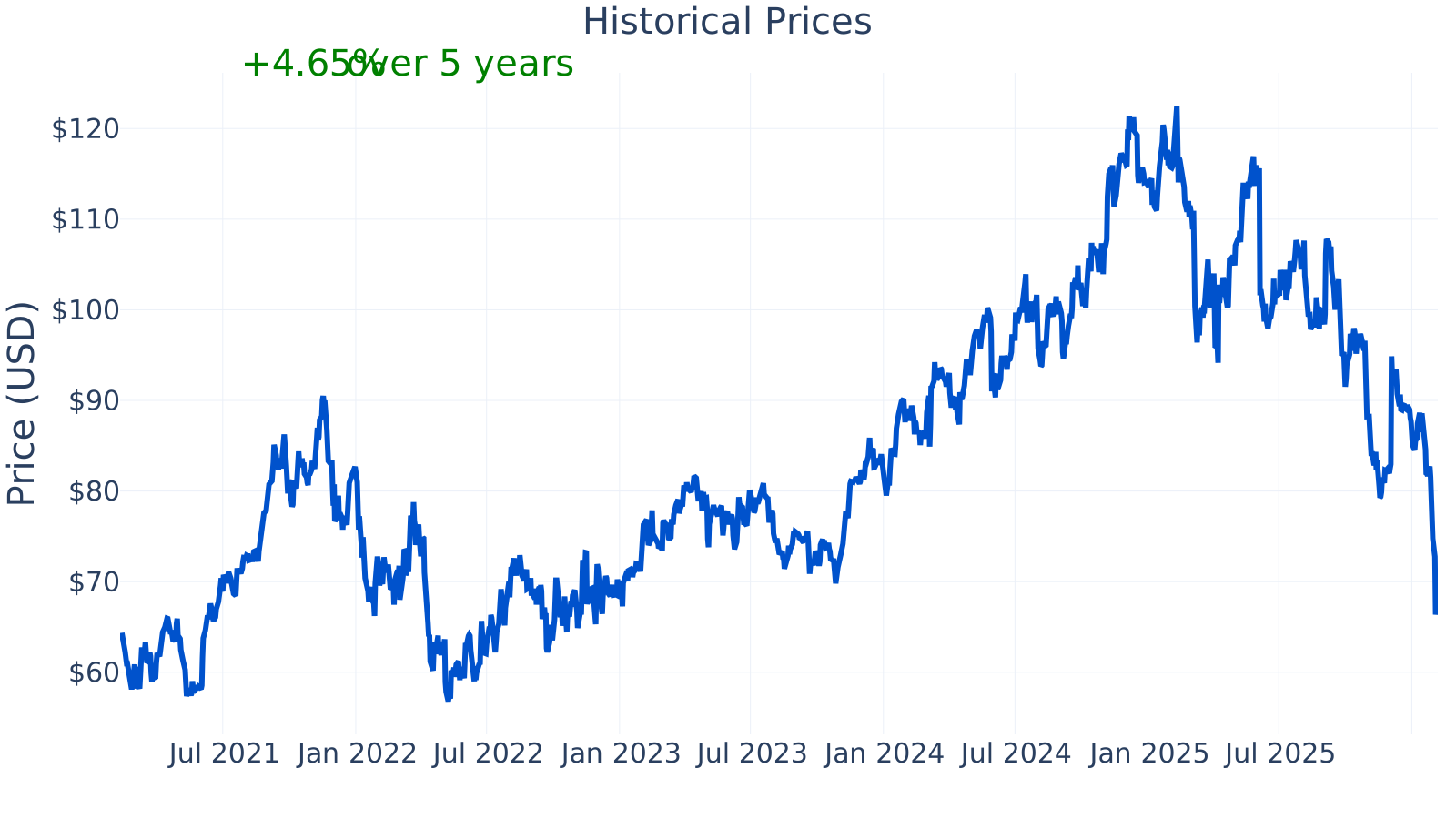
Descartes’ market capitalization is about $5.7B and the stock shows a low beta (~0.41), meaning it has historically moved less than the broader market on average. Profitability stands out: profit margin ~22.1% versus an industry median around 6.0%. Growth is positive but more moderate: year-over-year revenue growth ~11.2% compared with an industry median around 15.8%. Financial leverage is very low with debt-to-equity ~0.8% versus an industry median near 25.2%. Free cash flow over the trailing twelve months is about $244M, supporting the idea that reported earnings are backed by cash generation.
Growth (Medium)
Logistics software tends to benefit from long-term trends that push companies toward more digital, connected supply chains: tighter delivery expectations, higher complexity from cross-border trade, increased compliance requirements, and a desire for better shipment visibility and automation. These forces can persist even when freight volumes are cyclical, because many customers adopt software to reduce manual work and avoid costly errors.
Descartes’ strategy is oriented toward building a broad platform that can be expanded module by module. This can matter for long-term growth because logistics organizations often start with one pressing need (for example, customs filings or shipment visibility) and later add adjacent functions once the system is working. Acquisitions can also act as an accelerant by adding new capabilities and customer sets, though they come with integration and execution risk.
The year-over-year growth rate shown is consistently positive but varies over time, generally moving from higher growth rates earlier in the period toward low-teens more recently (around 10–13% in the latest points). That pattern can be consistent with a business that is scaling from a larger revenue base and operating in a market where demand is durable but not always fast-growing every quarter.
Free cash flow trends upward across the years shown (from roughly $171M to about $212M in the latest annual points), which can provide flexibility for reinvestment, acquisitions, and absorbing economic slowdowns without needing heavy borrowing.
Risks (Medium)
This article is for informational purposes only and does not constitute financial advice. Some content is AI-generated. See Disclaimer


