Stock Analysis · Celestica Inc (CLS)
Overview
Celestica Inc. (CLS) is a global provider of manufacturing and supply-chain services for technology and industrial companies. In simple terms, it helps other businesses design, build, test, and deliver complex electronic products at scale. This can range from assembling circuit boards and complete systems to managing parts sourcing, logistics, repairs, and product lifecycle services.
The company operates as a partner that sits between product brands and the physical production of hardware. Its role becomes especially important when products require high reliability, strict quality controls, and resilient supply chains—areas where customers may prefer experienced specialists rather than building everything in-house.
In its filings, Celestica typically describes revenue by operating segments rather than by a single “product” line. The two major segments are:
- Connectivity & Cloud Solutions (CCS) (typically the larger growth driver): solutions used in data centers, networking, and cloud-related infrastructure.
- Advanced Technology Solutions (ATS): a mix of end markets such as industrial, aerospace and defense, health tech, and other specialized industries.
Because customer programs can be large and concentrated, results can be influenced by a small number of major customers and how quickly those customers ramp (or pause) production.
Across the years shown, total revenue rises strongly (from about $5.6B in 2021 to about $12.6B in 2025), while net income expands even faster (from about $104M to about $847M). This points to a period where scale, mix, and execution translated into meaningfully higher profitability.
Key Figures
| Metric | Value | Industry ⓘ |
|---|---|---|
| Date | May 01, 2026 | |
| Context | ||
| Sector | Technology | |
| Industry | Electronic Components | |
| Market Cap ⓘ | $47.09B | |
| Beta ⓘ | 1.35 | |
| Fundamental | ||
| P/E Ratio ⓘ | 49.65 | 45.47 |
| Profit Margin ⓘ | 6.95% | 6.11% |
| Revenue Growth ⓘ | 52.80% | 17.40% |
| Debt to Equity ⓘ | 37.71% | 39.00% |
| PEG ⓘ | 1.00 | |
| Free Cash Flow ⓘ | $492.74M | |
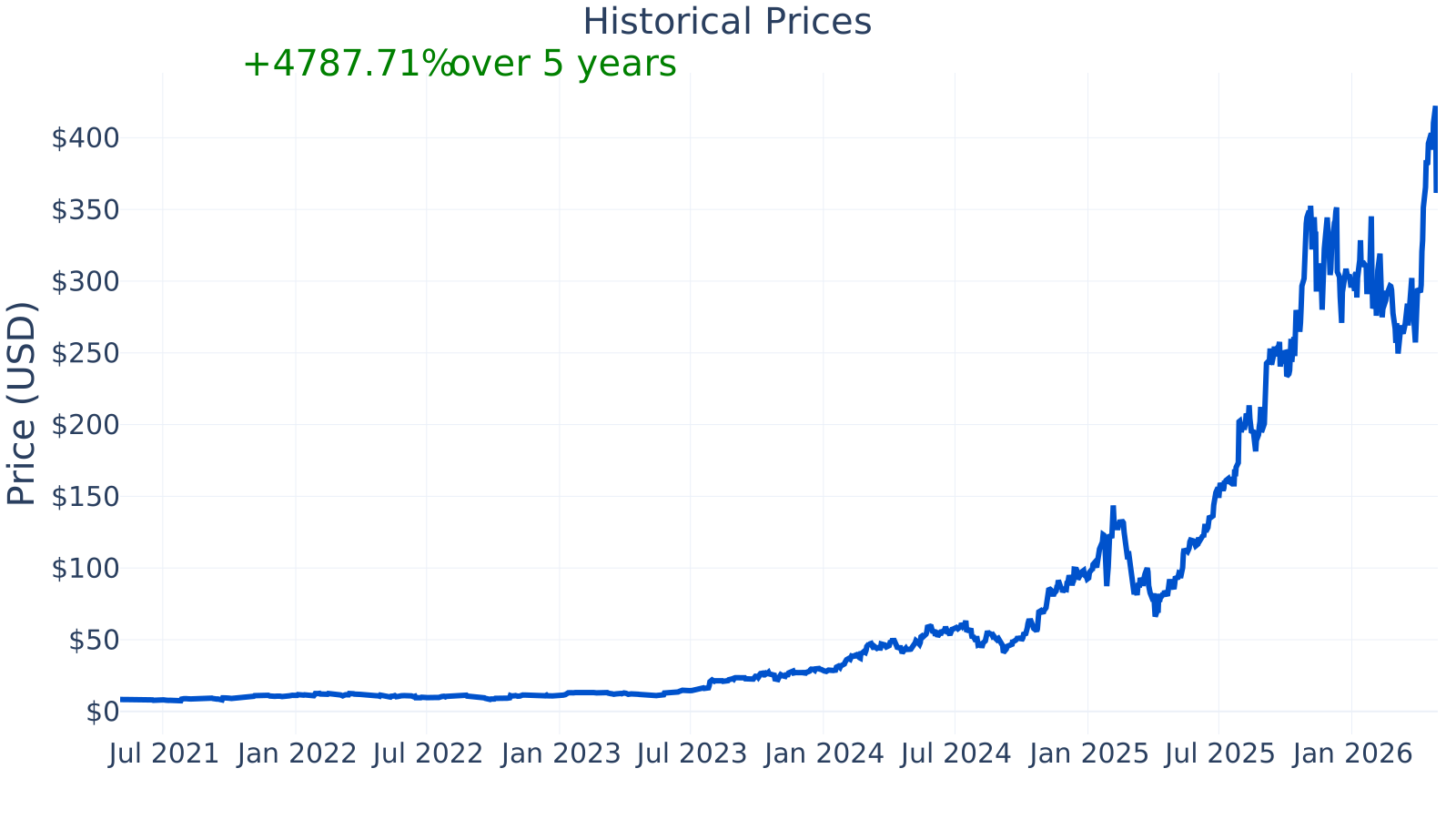
Celestica’s market capitalization is about $47.1B, and the stock shows above-market sensitivity with a beta of ~1.35 (meaning price swings have tended to be larger than the broader market). The latest P/E ratio is ~49.6, slightly above the industry median (~45.5). Profitability is solid versus peers, with a profit margin of ~7.0% versus an industry median near 6.1%. Recent growth stands out: year-over-year revenue growth of ~52.8% versus an industry median around 17.4%. Leverage appears moderate with debt-to-equity of ~37.7%, close to the industry median (~39.0%). Trailing twelve-month free cash flow is about $493M.
Growth (High)
Celestica operates in a part of the technology ecosystem that tends to benefit when demand rises for more computing, networking, and specialized electronics. When customers invest in data-center and connectivity infrastructure, they often need partners that can ramp production quickly, manage complex component sourcing, and meet stringent quality standards—especially during periods of supply-chain disruption or rapid product cycles.
The company’s recent growth rates indicate a strong ramp in demand and/or program wins. The year-over-year revenue growth trend shows a notable acceleration into the most recent period.
In the latest period shown, revenue growth reaches roughly 52.8% year over year, which is meaningfully above the industry median level shown in the table. It is also a higher rate than most of the preceding quarters in the series, where growth was frequently in the teens to 20% range after an earlier post-2021 rebound.
For long-term business strength, cash generation matters because it can support reinvestment, balance-sheet flexibility, and resilience through industry cycles.
Free cash flow trends upward over the periods shown, reaching about $493M in the latest trailing twelve months. While it fluctuates (including a dip around 2025 in the series), the more recent level is the highest in the range displayed, which is consistent with the broader improvement in profitability seen in the income statement flow.
Potential catalysts for continued growth typically come from (1) sustained build-outs in cloud and networking infrastructure, (2) capturing more complex, higher-value programs (which can improve margins), and (3) expanding services that go beyond assembly (for example, more engineering, integration, and lifecycle services). The main question for durability is whether recent growth is driven by multi-year customer programs versus shorter-cycle surges.
Risks (Medium)
A key risk for manufacturers and supply-chain partners is that revenue can be influenced by customer concentration and program timing. If a large customer slows orders, changes suppliers, redesigns a product, or shifts production strategy, a meaningful portion of sales can move quickly. This type of business can also be exposed to component availability, pricing pressure, and the need to continuously execute well on quality and delivery.
Another risk is cyclicality. Demand tied to data-center equipment, networking hardware, and electronics can move in waves depending on customer budgets, product transitions, and broader economic conditions. That can affect growth rates and factory utilization.
Debt levels can also shape resilience, especially during downturns, but the leverage shown here is not extreme relative to peers.
Debt-to-equity declines meaningfully from higher levels earlier in the series (often around 45%–55%, and peaking higher at times) to about 37.7% most recently, roughly in line with the industry median shown. That suggests the balance sheet, at least by this measure, has not become more stretched than peers despite the company’s expansion.
Profitability is another area to watch because contract manufacturing can be a competitive field where margins depend on mix, efficiency, and negotiating power with customers and suppliers.
Profit margin improves substantially over time in the series—from around 1.6%–2.1% in 2021–2022 to roughly 7.0% most recently—ending above the industry median shown in the latest metrics. That improvement can be a positive sign, but it also raises the question of how much is structural (better mix and capabilities) versus cyclical (particularly favorable demand conditions).
Competitive advantages in this industry often include deep customer relationships, proven quality systems, global footprint, the ability to handle complex builds, and reliable execution at scale. Celestica competes with other electronics manufacturing services providers and design/manufacturing partners. Commonly referenced peers in the EMS/technology manufacturing space include Jabil, Flex, Sanmina, and Plexus (among others). Positioning among these players often depends less on “being the biggest overall” and more on specializing in the right end markets, winning the right programs, and delivering consistent quality and cost performance over time.
Valuation
The P/E ratio trends upward over the period shown, moving from the low-to-mid teens earlier in the series to higher levels in 2025, and landing around 42.8 at the most recent point on the chart. The latest table value shows a current P/E around 49.6, which is slightly above the industry median listed (~45.5). In plain language, this indicates the market is placing a relatively high value on the company’s earnings compared with many peers, which often happens when investors expect strong growth or sustained margin improvement.
Whether this level is “high” or “low” depends heavily on how durable recent growth and profitability prove to be. With margins rising and revenue growth well above the peer median, the valuation level can be interpreted as reflecting stronger recent fundamentals. At the same time, higher valuation multiples generally leave less room for disappointment if growth slows or margins normalize.
Conclusion
Celestica is a manufacturing and supply-chain partner focused on complex electronics, with major exposure to cloud/connectivity infrastructure and other advanced technology end markets. Over the periods shown, the business demonstrates strong expansion in revenue and a large improvement in profitability, alongside rising free cash flow and moderate leverage relative to the industry median.
The main uncertainties for a long-term view are the typical ones for this type of company: customer and program concentration, industry cyclicality, and the sustainability of recently improved margins. Valuation metrics indicate the market is assigning a relatively elevated earnings multiple compared with the industry median, which aligns with the company’s strong recent growth but can increase sensitivity to changes in expectations.
Sources:
- Celestica Inc. — Annual Report (Form 10-K) (Business overview, segments, risk factors, financial statements)
- SEC EDGAR — Celestica Inc. filings (10-K, 10-Q, 8-K)
- Celestica Investor Relations — Earnings releases and investor materials
- Wikipedia — “Celestica” (basic company background)
This article is for informational purposes only and does not constitute financial advice. Some content is AI-generated. See Disclaimer