Stock Analysis · Celestica Inc (CLS)
Overview
Celestica Inc. (CLS) is a global company that helps other businesses design, build, and manage complex electronic products. Instead of selling consumer gadgets under its own brand, Celestica mainly works “behind the scenes” for customers in areas like cloud computing and data centers, communications equipment, industrial systems, aerospace and defense, and other specialized markets. Its work typically includes manufacturing, supply chain and logistics support, and (in some programs) engineering and design services.
At a high level, Celestica earns money by delivering products and services to business customers under manufacturing and services agreements. Revenue is commonly discussed by business lines (rather than by single products), and these programs can be large and multi-year but also dependent on customer demand cycles.
Main sources of revenue are generally described in company reporting as:
- Connectivity & Cloud Solutions (CCS) (often associated with cloud/data center and communications-related programs)
- Advanced Technology Solutions (ATS) (often associated with industrial, aerospace & defense, health tech and other specialized markets)
Percentages by segment can vary year to year and depend on the company’s latest filings; the most reliable split is the one provided in Celestica’s annual report and quarterly reports.
Across recent years shown above, total revenue rose meaningfully (from about $5.6B in 2021 to about $12.6B in 2025), while net income also increased (from about $104M to about $847M). This combination suggests that the company has not only expanded its activity, but also improved how much profit it keeps after costs, operating expenses, interest, and taxes.
Key Figures
| Metric | Value | Industry ⓘ |
|---|---|---|
| Date | Feb 07, 2026 | |
| Context | ||
| Sector | Technology | |
| Industry | Electronic Components | |
| Market Cap ⓘ | $35.48B | |
| Beta ⓘ | 1.50 | |
| Fundamental | ||
| P/E Ratio ⓘ | 42.89 | 41.23 |
| Profit Margin ⓘ | 6.72% | 6.11% |
| Revenue Growth ⓘ | 43.60% | 12.20% |
| Debt to Equity ⓘ | 35.04% | 39.00% |
| PEG ⓘ | 19.42 | |
| Free Cash Flow ⓘ | $459.54M | |
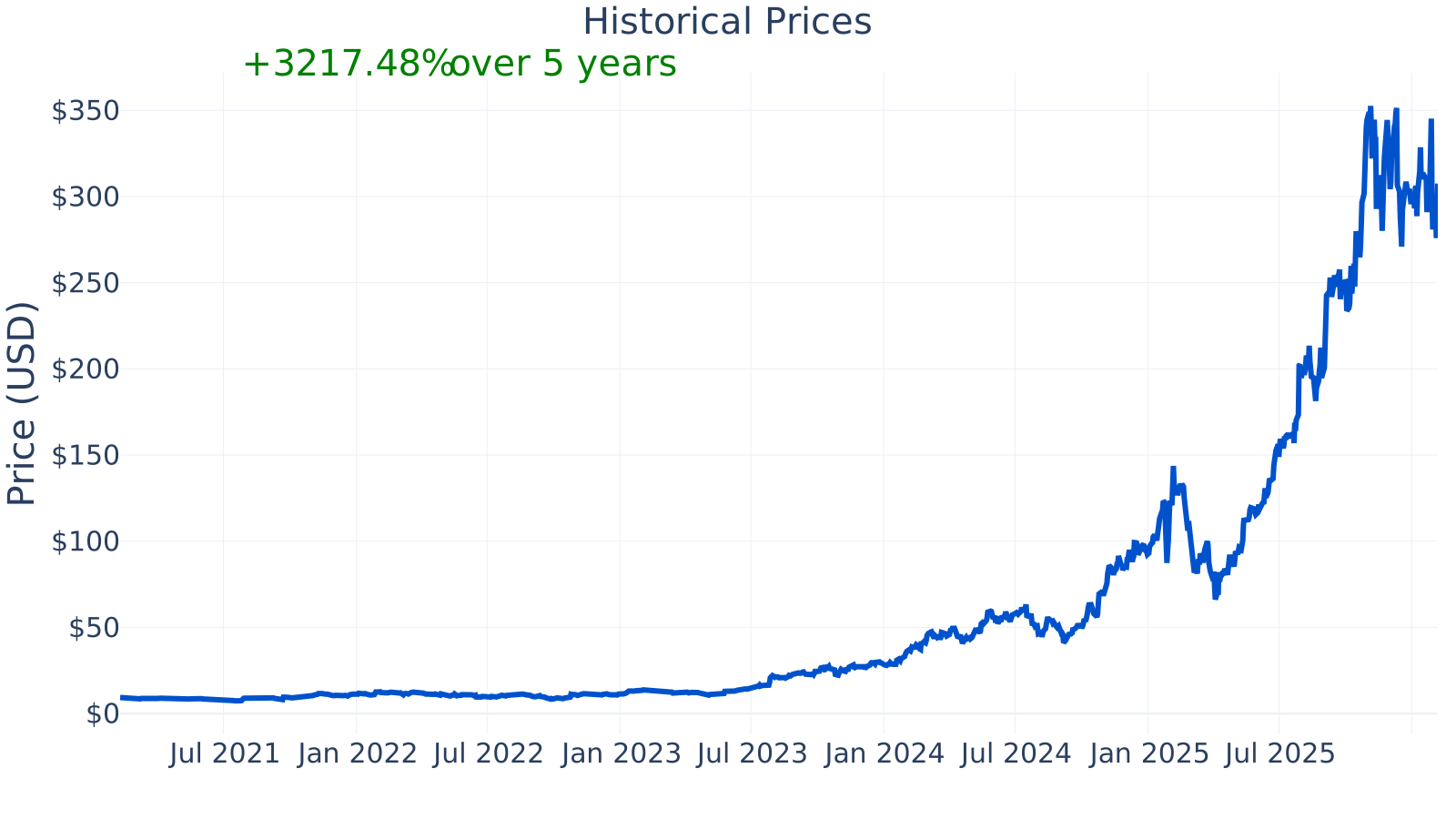
Celestica’s market capitalization is about $35.5B. The stock’s beta of ~1.5 indicates it has historically moved more than the broader market (higher volatility than the market average). The P/E ratio is ~42.9, close to the industry median (~41.2), meaning the market is valuing CLS at a similar earnings multiple to peers in its listed industry group. Current profit margin is ~6.7% (industry median ~6.1%), and year-over-year revenue growth is ~43.6% (industry median ~12.2%), indicating faster recent top-line expansion than the typical peer. Debt-to-equity is ~35% versus an industry median near ~39%, suggesting moderate leverage relative to peers. Trailing twelve-month free cash flow is about $460M, reflecting cash generation after operating needs and capital spending.
Growth (Medium)
Celestica operates in electronics manufacturing services and related engineering/supply-chain work, which tends to benefit when customers increase spending on data-center infrastructure, networking equipment, and specialized industrial or aerospace programs. These end markets can be long-lived, but they are also cyclical: demand can accelerate quickly and then normalize as customers digest capacity.
A central part of Celestica’s growth logic is that many customers prefer to outsource complex manufacturing and supply chain execution to specialized partners. When that trend holds, companies like Celestica can gain share by demonstrating quality, reliability, cost control, and the ability to scale across regions.
Revenue growth improved substantially from declines in 2021 to strong positive growth through 2022–2025, finishing at roughly 45.8% year-over-year in the latest point shown. That is notably above the listed industry median in the table, suggesting Celestica has recently been expanding faster than many peers (though high growth rates can be harder to sustain over long periods).
Free cash flow has also increased over time in the period shown (from about $152M in 2021 to a peak around $333M in 2024, and about $282M at the latest point shown in 2025). For long-term business quality, cash generation matters because it can support reinvestment, debt reduction, and resilience during weaker demand cycles.
Risks (High)
This article is for informational purposes only and does not constitute financial advice. Some content is AI-generated. See Disclaimer