Stock Analysis · Canadian Solar Inc (CSIQ)
Overview
Canadian Solar Inc. (CSIQ) is a global solar company active across the solar value chain. It sells solar modules and related equipment and also develops and supplies energy storage solutions. The company’s activities typically span manufacturing/procurement of solar products, selling to distributors and project customers, and participating in project development and services through its broader platform.
In simple terms, CSIQ mainly makes money by delivering solar panels (modules) and by providing solutions tied to building and operating solar and storage projects. These end markets are influenced by electricity demand growth, grid upgrades, renewable energy targets, and financing conditions for large infrastructure projects.
The most common revenue “buckets” for Canadian Solar (as described in company reporting) include:
- Solar module and system product sales (solar panels and related hardware)
- Energy storage solutions (battery storage products and solutions)
- Project-related and services revenue (development, EPC-related activities, and other services, depending on period and structure)
Public filings can change how these lines are grouped over time (for example, when business units are reorganized or when certain activities are held in different subsidiaries), so exact percentages can vary by reporting period and segment definitions.
Across 2021–2024, revenue rose from about $5.28B (2021) to $7.61B (2023) before declining to about $5.99B (2024). Over the same span, operating income and net income compressed sharply in 2024 (operating income about $55M, net income about $36M), while interest expense increased (about $137M in 2024 versus about $58M in 2021), highlighting how profitability can swing with pricing, costs, and financing conditions.
Key Figures
| Metric | Value | Industry ⓘ |
|---|---|---|
| Date | Mar 16, 2026 | |
| Context | ||
| Sector | Technology | |
| Industry | Solar | |
| Market Cap ⓘ | $1.23B | |
| Beta ⓘ | 1.30 | |
| Fundamental | ||
| P/E Ratio ⓘ | N/A | 30.52 |
| Profit Margin ⓘ | 0.27% | 7.06% |
| Revenue Growth ⓘ | -1.30% | 11.10% |
| Debt to Equity ⓘ | 257.96% | 104.92% |
| PEG ⓘ | 0.16 | |
| Free Cash Flow ⓘ | -$1.73B | |
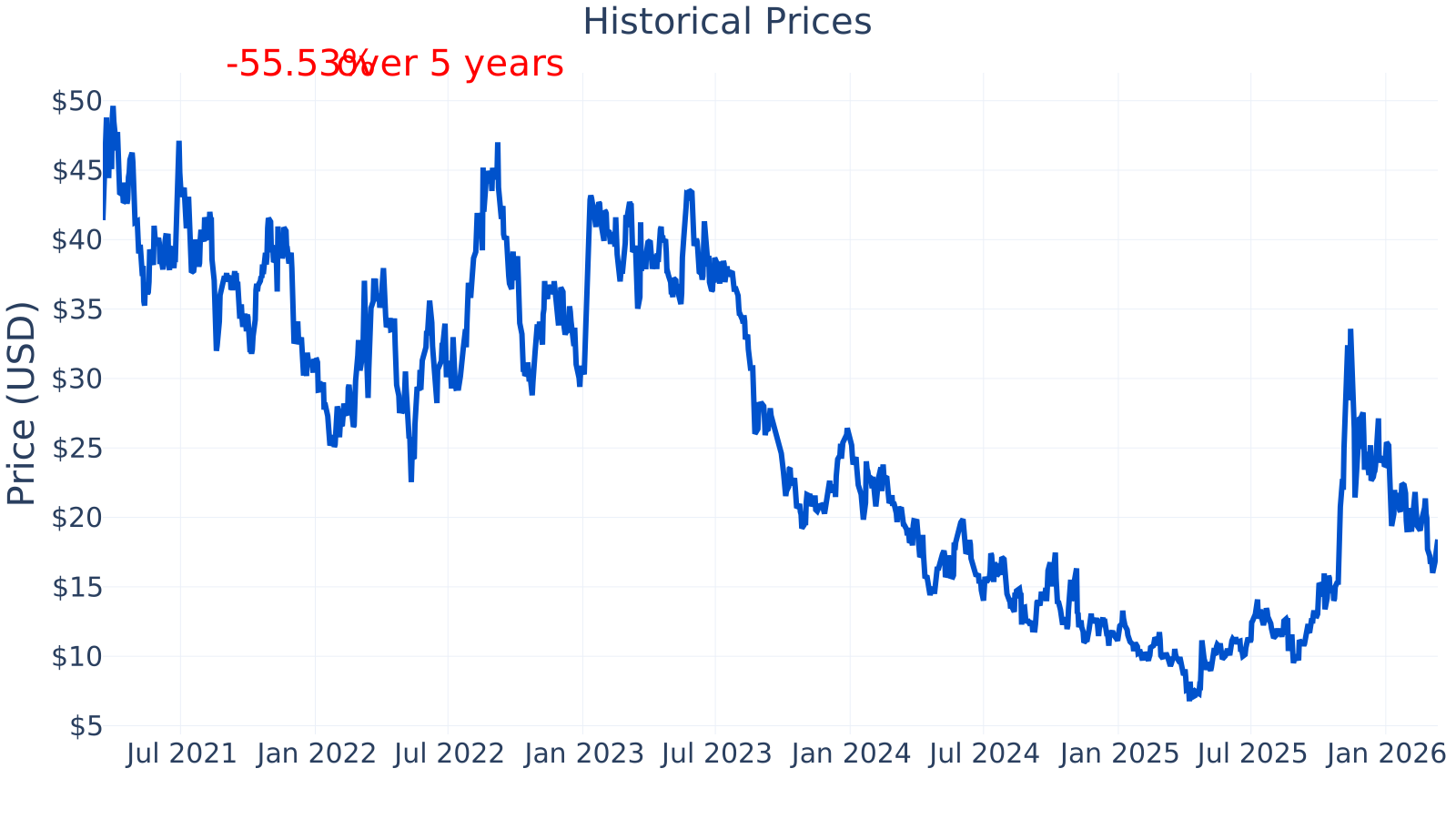
Canadian Solar’s market capitalization is about $1.23B, and its beta is about 1.31, which is consistent with a stock that has tended to move more than the broader market. Profitability is currently thin: the latest profit margin shown is about 0.27%, below the industry median of about 7.06%. Year-over-year revenue growth is slightly negative at about -1.34%, compared with an industry median around 11.1%. Leverage is elevated: debt-to-equity is about 258% versus an industry median near 105%. Free cash flow (trailing twelve months) is negative at about -$1.73B.
Growth (Medium)
Solar and grid-scale energy storage are part of a broader, long-running shift in the global energy system toward lower-carbon electricity. Demand drivers typically include continued growth in electricity consumption, replacement of aging generation assets, and policy or regulatory support for renewables and grid reliability. In that context, Canadian Solar operates in an industry with structural tailwinds, but one that can be highly cyclical due to pricing pressure, changes in incentives, and project financing conditions.
The year-over-year revenue growth pattern shown is volatile: strong growth in 2021–2022, slowing in 2023, then a period of contraction across much of 2024, and mixed performance into 2025. This kind of uneven trajectory is common in solar manufacturing and project-driven businesses, where product pricing can move quickly and the timing of large project deliveries can shift revenue between quarters.
The free cash flow trend is meaningfully negative over the periods shown (including a larger outflow by 2025). For long-term business building, negative free cash flow can occur during expansion phases (for example, when working capital rises or when capacity and project pipelines require investment). However, persistently negative free cash flow can also signal that profitability and cash conversion are under pressure, especially when combined with higher borrowing costs.
Potential catalysts for future growth (in a neutral, factual sense) generally include: normalization of solar module pricing after downcycles, improved spreads between selling prices and input costs, expansion of energy storage deployments, and stronger project execution (timely delivery and monetization of a development pipeline). Whether these catalysts translate into sustained results depends on market conditions and company execution.
Risks (High)
Canadian Solar’s risk profile is closely tied to the solar industry’s competitive dynamics and the capital intensity of manufacturing and project activity. Solar modules can behave like a commodity product in many markets, which often leads to price competition and margin pressure. When prices fall faster than costs, profitability can compress quickly.
Leverage is high versus the industry median in the periods shown, ending around 258% debt-to-equity. Higher leverage can amplify outcomes in both directions: it can support growth when conditions are favorable, but it can also increase sensitivity to interest rates, refinancing needs, and cyclical downturns. The same period also shows rising interest expense in the income flow summarized earlier, which is consistent with financing becoming a bigger factor in net results.
Profit margins have trended down materially from earlier highs in 2023 to very low levels around 2024–2025, including slightly negative quarters, while the industry median remains higher. Thin margins reduce the room to absorb pricing shocks, warranty or quality issues, trade/tariff disruptions, or project delays.
Competition is intense across solar manufacturing and energy storage. Large global module suppliers and vertically integrated players can compete on cost, scale, and supply chain access, while project developers and storage integrators compete on financing, execution track record, and customer relationships. Canadian Solar is a well-known global participant, but not a single-category “winner-takes-most” business; competitive advantages tend to be more operational (scale, sourcing, bankability with project financiers, and global customer reach) than protected by strong switching costs.
Additional key risks commonly disclosed in filings for companies in this space include trade policy and tariffs, changes in renewable incentives, customer concentration in some channels, foreign exchange exposure, and execution risk on large projects (cost overruns, permitting, interconnection delays, and timing of asset sales or transfers).
Valuation
The P/E history shown is uneven, with periods where the ratio is low (single digits in parts of 2023–2024) and a much higher value later (about 125 at the end of 2025 in the series shown). P/E can become difficult to interpret when earnings are temporarily depressed or volatile: a small change in net income can cause the P/E to swing sharply even if the stock price does not move much. The industry median P/E shown in the series generally sits well below earlier triple-digit levels and is around the mid‑20s by the end of 2025.
Given the combination of very thin profit margin, negative free cash flow (TTM), and higher leverage relative to the industry median, valuation analysis tends to hinge less on a single multiple and more on whether profitability and cash generation can normalize through the cycle. In other words, the “cheap vs. expensive” framing is highly sensitive to future margins, working capital needs, and financing conditions.
Conclusion
Canadian Solar is positioned in solar and energy storage—areas with long-term demand drivers tied to electrification and renewable generation buildout. At the same time, the business profile shown here reflects an industry that can be cyclical and highly competitive, with results that can change quickly as pricing, costs, and project timing shift.
Based on the metrics and trends presented, the main points for a long-term evaluation are the recent compression in profitability (profit margin near zero), negative trailing free cash flow, and above-median leverage. The key question for long-horizon fundamentals is whether operating performance can recover to levels that sustainably support cash generation while managing debt and interest costs through different market environments.
Sources:
- SEC EDGAR — Canadian Solar Inc. annual reports (Form 10-K) and quarterly reports (Form 10-Q)
- Canadian Solar Inc. Investor Relations — SEC filings and investor materials (company-hosted)
- Wikipedia — “Canadian Solar” (basic company background)
This article is for informational purposes only and does not constitute financial advice. Some content is AI-generated. See Disclaimer


