Stock Analysis · Boyd Group Services Inc (BGSI)
Overview
Boyd Group Services Inc. (BGSI) operates a network of auto body repair shops focused on collision repair and related services. In simple terms, it fixes vehicles after accidents and manages the repair process for customers, insurers, and vehicle fleets. The company is known for operating at scale across multiple locations, with a business model that tends to emphasize standardized processes, relationships with insurance partners, and ongoing acquisition of repair centers to expand its footprint.
Revenue is largely driven by repair work that is paid for by insurance companies and customers. In annual reporting, Boyd typically describes revenue in broad service categories rather than consumer-style “product lines.” A simplified way to think about its main revenue streams is:
- Collision repair services (the core of the business; repairs after accidents, commonly insurance-paid)
- Refinishing/paint and related labor (often bundled into collision repair jobs)
- Parts and materials (replacement parts, paint/materials used in repairs)
- Other services (towing, glass, minor add-ons depending on location and mix)
Because publicly available filings may not break out a clean percentage by each of the categories above in a consistent “% of revenue” format, the most reliable takeaway is that collision repair is the dominant driver, with parts/materials and labor forming the economic engine of each repair order.
Across the period shown, total revenue increased materially from 2021 through 2025, but profitability did not move in a straight line. Interest expense rose over time, and net income in 2024–2025 appears relatively low compared with the revenue base, which is consistent with a business facing margin pressure and/or higher operating and financing costs.
Key Figures
| Metric | Value | Industry ⓘ |
|---|---|---|
| Date | Mar 23, 2026 | |
| Context | ||
| Sector | Consumer Cyclical | |
| Industry | Auto & Truck Dealerships | |
| Market Cap ⓘ | $3.94B | |
| Beta ⓘ | 0.57 | |
| Fundamental | ||
| P/E Ratio ⓘ | 172.18 | 17.58 |
| Profit Margin ⓘ | 0.59% | 2.54% |
| Revenue Growth ⓘ | 5.50% | 3.90% |
| Debt to Equity ⓘ | 99.84% | 157.29% |
| PEG ⓘ | N/A | |
| Free Cash Flow ⓘ | $287.44M | |
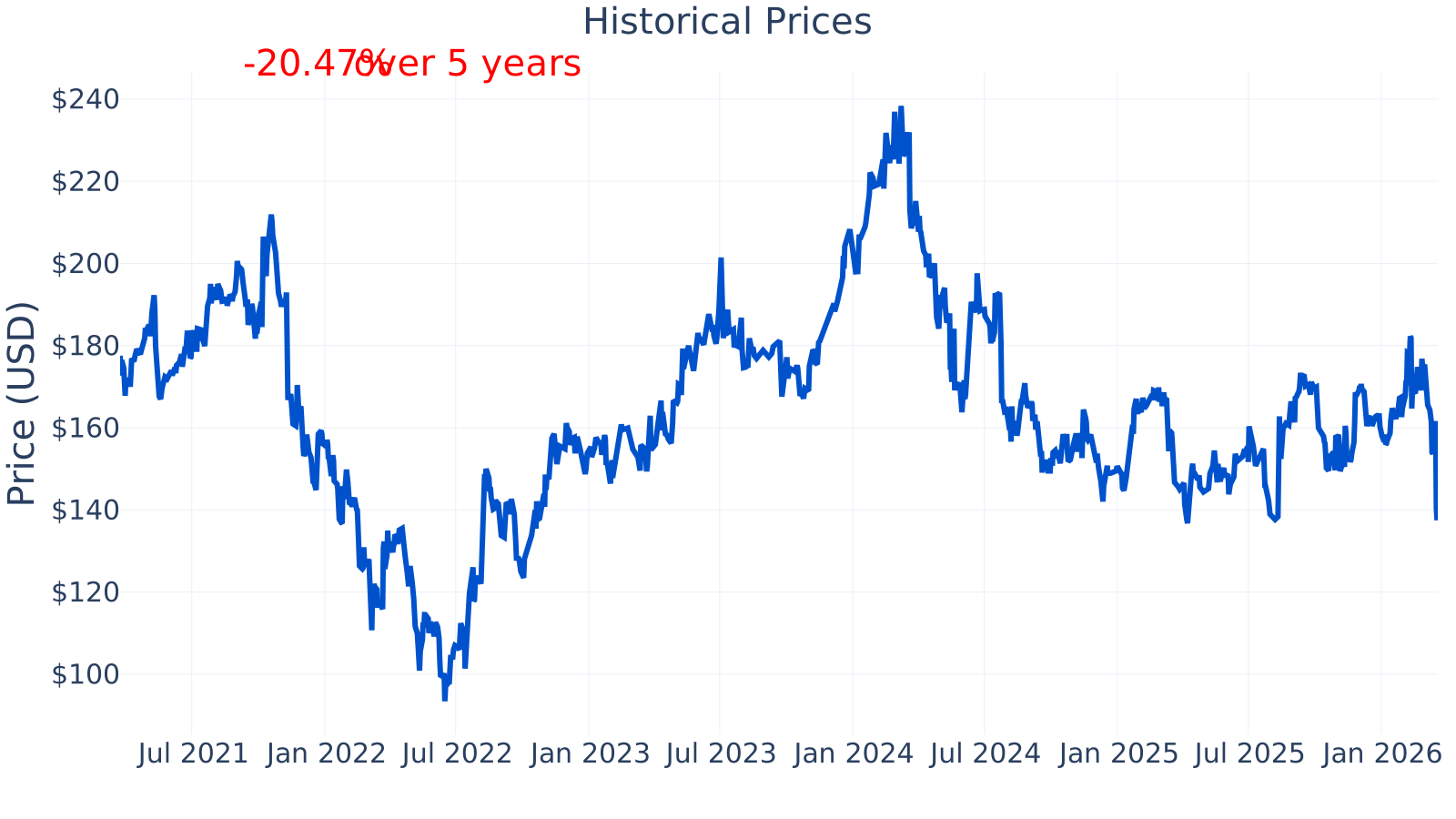
Boyd’s market capitalization is about $3.94B, and the stock’s beta (~0.57) suggests it has historically moved less than the broader market. The latest P/E ratio (~172) is far above the industry median (~17.6), while the latest profit margin (~0.59%) is well below the industry median (~2.54%). Revenue growth year over year is about 5.5%, slightly above the industry median shown (3.9%). Debt-to-equity is about 99.8%, below the industry median shown (about 157%). Trailing twelve-month free cash flow is about $287M.
Growth (Medium)
Collision repair is generally supported by a large installed base of vehicles on the road and the ongoing need for accident repairs. Demand is not purely discretionary: even in weaker consumer environments, insured collision events still occur, and repairs are often necessary to return vehicles to service. At the same time, growth can be influenced by factors such as miles driven, severity of accidents (which affects repair complexity), claims-handling practices by insurers, and the availability/cost of parts and labor.
Boyd’s strategy has historically relied on scaling a multi-location platform, which can matter in an industry where procurement (parts/materials), training, cycle-time management, and insurer relationships can improve with size. Scale can also support investments in estimating systems, repair planning, and process consistency across locations. However, the benefits of scale must translate into stable or improving margins to be clearly visible in results.
The year-over-year revenue growth shown moves from low single digits and a small decline (early 2025) to a stronger pace later in 2025 (about 5.0% and 7.1% in the most recent quarters displayed). This pattern suggests growth re-accelerated, but it also indicates variability from quarter to quarter.
Trailing free cash flow shown is positive (about $254M at 2024-09-30 and about $225M at 2025-03-31, with the latest metric table showing about $287M). Positive free cash flow can provide flexibility for acquisitions, reinvestment, or debt management, but it is still important to pair it with operating margin trends and the cost of financing.
Risks (High)
Boyd operates in a service business where execution and cost control matter. A key risk is profitability pressure: labor is a major input, technician availability can be constrained, wage inflation can be persistent, and parts prices and repair complexity can shift. In addition, collision repairers often negotiate with insurers, and changes in insurer reimbursement practices (labor rates, parts usage, required procedures, cycle-time expectations) can affect shop-level economics.
Profit margin in the period displayed trends down from about 1.35% (2024-09-30) to roughly 0.26% (2025-06-30), then recovers modestly to about 0.59% (2025-12-31). Throughout the period shown, Boyd’s margin remains below the industry median (roughly 2.2%–2.8%). This gap can reflect a mix of factors such as integration costs, labor/parts dynamics, pricing/reimbursement pressure, or other operating expenses.
Another risk is integration and acquisition execution. A roll-up strategy can add scale, but it also creates ongoing work: integrating systems, retaining technicians and managers, aligning repair processes, and maintaining consistent customer/insurer service levels. If integration is slower or more expensive than planned, profitability can be affected even when revenue rises.
Debt-to-equity trends down meaningfully in the most recent point shown (to about 99.8% at 2025-12-31 from roughly 150%–159% earlier in 2024–2025). While this is below the industry median shown, the overall level still indicates that leverage is a meaningful part of the capital structure. Rising interest expense (visible in the income flow view over time) highlights sensitivity to borrowing costs and refinancing conditions.
On competitive positioning, Boyd is commonly viewed as one of the larger multi-shop collision repair operators in North America, which can provide advantages in insurer relationships, sourcing, and process investment. Competition remains intense and includes other large consolidators and many local and regional independent body shops. Large competitors can also pursue acquisitions and insurer programs, while independent shops may compete strongly on local relationships and specialized repair capabilities.
Valuation
The P/E ratios shown are consistently far above the industry median during the displayed dates (for example, roughly 78 vs. 26 in late 2024, then rising above 200 while the industry median stays around the high teens). The latest metric table also shows a P/E around 172 versus an industry median around 17.6. A high P/E can happen when the market expects stronger future earnings, when earnings are temporarily depressed (making the “E” small), or when a company has characteristics that investors value (scale, consistency, or perceived durability). Given the low profit margins shown, the elevated P/E appears more consistent with currently low earnings relative to price and/or expectations that profitability improves over time.
Whether today’s price level is “expensive” depends largely on future margin normalization, the pace and profitability of growth (including acquisitions), and the company’s ability to manage labor/parts/insurer dynamics. With margins below the industry median in the period shown, valuation sensitivity to earnings improvement is likely to be high.
Conclusion
Boyd Group Services operates a scaled collision repair platform in an industry supported by ongoing vehicle repair needs. The business has shown meaningful revenue expansion over multiple years, and recent quarters show improving year-over-year growth. Free cash flow is positive in the periods shown, and leverage (debt-to-equity) improved at the most recent point displayed.
At the same time, the most visible fundamental challenge in the numbers shown is profitability: net margin is low and has been below the industry median across the recent periods displayed. Interest expense has also risen over time, which can matter when margins are thin. Valuation metrics based on earnings (P/E) are substantially higher than the industry median, which makes the overall picture more dependent on future improvements in profitability and execution.
Sources:
- U.S. SEC EDGAR — Company filings for Boyd Group Services Inc (Annual Reports / Form 40-F and related filings, plus interim reports where applicable)
- Boyd Group Services Inc — Investor Relations materials (public filings and releases posted by the company)
- Wikipedia — “The Boyd Group” (basic company background)
This article is for informational purposes only and does not constitute financial advice. Some content is AI-generated. See Disclaimer


