Stock Analysis · Boyd Group Services Inc (BGSI)
Overview
Boyd Group Services Inc. (BGSI) operates a network of auto body repair shops. In simple terms, it helps drivers and fleet operators fix vehicles after collisions. The company runs repair centers under well-known local and regional brands, and it also provides related services that support the repair process (for example, helping coordinate repairs and parts, and working with insurance claims workflows).
Revenue is primarily generated when a vehicle is repaired and the bill is paid—most often by insurance companies (because collision repairs are commonly covered by auto insurance), and also by customers paying out of pocket and commercial customers such as fleets.
Main revenue sources are typically organized around collision repair work and customer type. Public filings generally emphasize collision repair as the core activity, with additional related services and programs as smaller contributors. Percentages by source can vary by reporting period and disclosure format.
Over the last several years, total revenue increased meaningfully (from about $1.87B in 2021 to about $3.07B in 2024). Over the same period, operating income and net income were more volatile, with 2024 showing significantly lower net income than 2023, alongside higher interest expense—an indication that higher operating costs and financing costs can materially affect bottom-line results even when revenue is rising.
Key Figures
| Metric | Value | Industry ⓘ |
|---|---|---|
| Date | Feb 23, 2026 | |
| Context | ||
| Sector | Consumer Cyclical | |
| Industry | Auto & Truck Dealerships | |
| Market Cap ⓘ | $4.80B | |
| Beta ⓘ | 0.55 | |
| Fundamental | ||
| P/E Ratio ⓘ | 228.43 | 19.15 |
| Profit Margin ⓘ | 0.52% | 2.54% |
| Revenue Growth ⓘ | 5.00% | 3.90% |
| Debt to Equity ⓘ | 158.71% | 157.49% |
| PEG ⓘ | N/A | |
| Free Cash Flow ⓘ | $288.62M | |
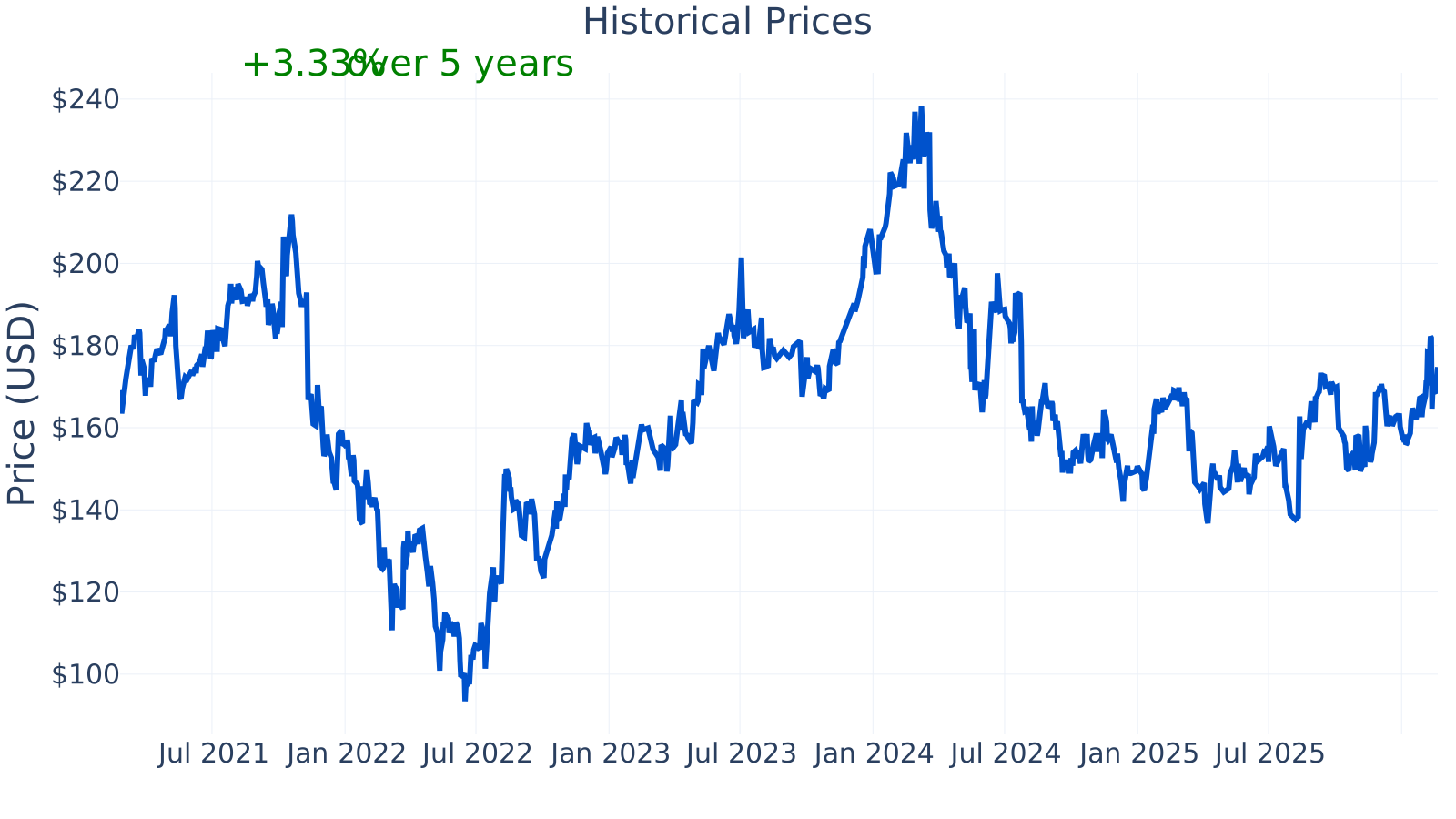
Boyd Group’s market capitalization is about $4.8B and its beta is about 0.55, which indicates the stock has historically moved less than the broader market (though beta can change over time). The company’s profit margin is about 0.52%, below the industry median of about 2.54%, meaning a relatively small portion of each dollar of revenue has recently turned into profit. Year-over-year revenue growth is about 5.0%, slightly above the industry median of about 3.9%. Debt-to-equity is about 159%, roughly in line with the industry median (~157%), which suggests a balance sheet that relies meaningfully on debt financing. Trailing twelve-month free cash flow is about $289M.
Growth (Medium)
Auto collision repair tends to be a steady, everyday-need category: accidents happen in all economic environments, and damaged vehicles often must be repaired to be safely driven. That said, growth is not purely “automatic.” It depends on factors such as miles driven, repair complexity (newer cars can be more expensive to fix), parts availability, labor capacity, and how insurance reimbursement trends evolve.
A common long-term strategy in this industry is to grow by expanding shop count and improving same-store performance through better procurement, standardized processes, and relationships with insurance partners and fleet programs. For a large operator like Boyd, scale can matter because it can support centralized purchasing, training, and throughput improvements—if executed well.
Recent year-over-year revenue growth has fluctuated around low single digits, including a small contraction earlier in 2025 (around -1.0%) and a rebound to about +5.0% by 2025-09-30. This pattern suggests growth may be sensitive to near-term operating conditions (repair volumes, pricing, or capacity) rather than following a smooth upward line every quarter.
Free cash flow (cash generated after operating needs and capital spending) is positive, with trailing twelve-month figures in the ~$225M–$254M range in the periods shown, and about $289M on the latest table. Positive free cash flow can be important in a roll-up style business because it can help fund new shop openings, acquisitions, facility upgrades, and debt repayment—though the stability of that cash flow across cycles is what long-term owners typically watch.
Risks (Medium-High)
This article is for informational purposes only and does not constitute financial advice. Some content is AI-generated. See Disclaimer