Stock Analysis · BlackBerry Ltd (BB)
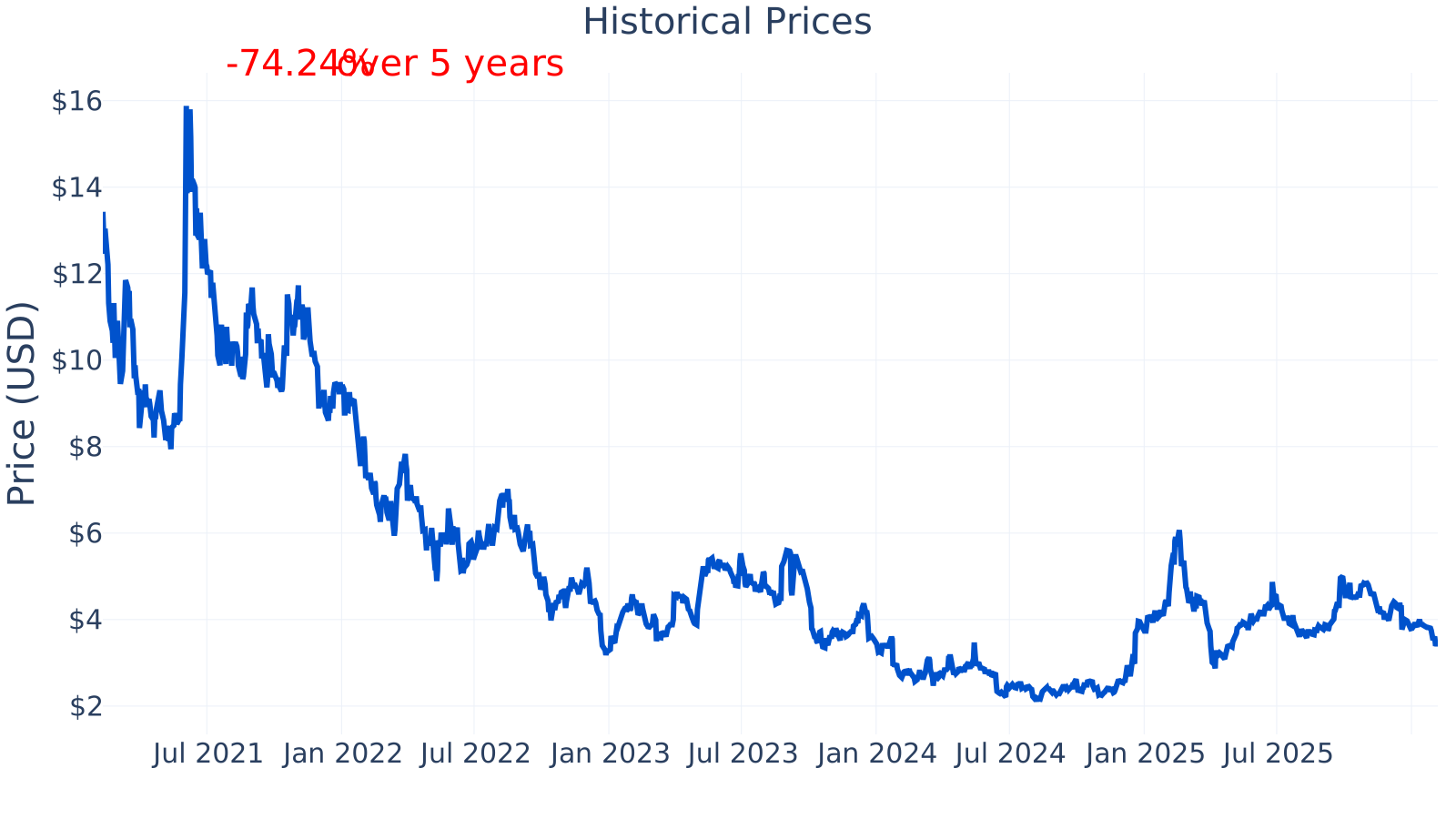
Overview
BlackBerry Ltd is a software company focused on security and embedded systems. After exiting the smartphone hardware business years ago, the company has concentrated on software used in (1) connected and safety-critical devices—especially vehicles—and (2) cybersecurity products and services for organizations.
In its public reporting, BlackBerry generally discusses revenue in two main streams:
- IoT (Internet of Things): Primarily the QNX software platform used in embedded systems (notably in automotive and other industrial devices), plus related development tools and services.
- Cybersecurity: Security software and services, including endpoint and enterprise security offerings.
Exact revenue percentages by segment can change year to year and depend on the period presented in filings. The company provides segment-level breakdowns in its annual report (Form 10-K / annual information).
At a high level, the company’s financial picture in recent years has been shaped by (a) the mix between higher-margin software revenue and operating costs needed to maintain and develop products, and (b) uneven top-line performance as it refocuses the business.
The multi-year income flow shows meaningful swings in revenue and profitability. Operating expenses (including research and development and selling, general, and administrative costs) have been large relative to revenue for portions of the period shown, which helps explain why net income has been volatile even when gross profit is positive.
Key Figures
| Metric | Value | Industry ⓘ |
|---|---|---|
| Date | Feb 08, 2026 | |
| Context | ||
| Sector | Technology | |
| Industry | Software - Infrastructure | |
| Market Cap ⓘ | $2.04B | |
| Beta ⓘ | 1.34 | |
| Fundamental | ||
| P/E Ratio ⓘ | 86.50 | 25.67 |
| Profit Margin ⓘ | 4.02% | 6.91% |
| Revenue Growth ⓘ | -1.30% | 15.20% |
| Debt to Equity ⓘ | 2.87% | 19.82% |
| PEG ⓘ | N/A | |
| Free Cash Flow ⓘ | $39.28M | |
BlackBerry’s market capitalization is about $2.04B. The stock’s beta (~1.35) indicates it has tended to be more volatile than the overall market. The latest P/E ratio (~86.5) is much higher than the industry median (~25.7), which typically means the market price is high relative to current earnings; however, P/E ratios can be less informative when profits are small or have been inconsistent. The latest profit margin (~4.0%) is below the industry median (~6.9%). Latest year-over-year revenue growth (~-1.3%) is well below the industry median (~15.2%). On leverage, debt-to-equity (~2.9%) is far below the industry median (~19.8%). Trailing twelve-month free cash flow is about $39.3M.
Growth (Medium)
BlackBerry operates in areas that are structurally important over the long term: embedded software for connected devices (including vehicles) and cybersecurity. Both areas are supported by broad trends such as increasing software content in cars and growing security needs as organizations manage more endpoints and connected systems.
The growth question for BlackBerry is less about whether these markets exist and more about whether the company can translate its product footprint into sustained revenue expansion and durable profitability. The company’s strategy has emphasized focusing resources on core software platforms and security offerings, while managing costs.
The year-over-year revenue pattern shown is uneven, with multiple periods of contraction and only occasional spikes. More recently, growth has been close to flat to slightly negative (around -1% to +3% in the most recent points shown), which contrasts with a much higher typical growth rate for the broader software infrastructure peer group.
Free cash flow has improved from deeply negative levels (including a low around -$304M in the period shown) toward positive territory, reaching about $39M on a trailing basis in the latest point. For long-term business durability, consistently positive free cash flow can matter because it indicates the company may be generating cash after operating needs and capital spending, rather than relying primarily on financing.
Potential catalysts discussed in company materials often relate to expanding the installed base and monetization in embedded software (design wins converting into royalties over time), as well as stabilizing and improving performance in cybersecurity. The timing and magnitude of these catalysts can be difficult to forecast because enterprise security spending cycles and automotive production/launch cycles can be lumpy.
Risks (High)
This article is for informational purposes only and does not constitute financial advice. Some content is AI-generated. See Disclaimer


