Stock Analysis · Viking Holdings Ltd (VIK)
Overview
Viking Holdings Ltd (VIK) operates in the travel services industry and is best known for its Viking-branded cruises. In simple terms, the company designs and sells cruise itineraries and onboard experiences, then earns money when guests pay fares (and also spend on certain onboard and travel-related items). Because cruises combine transportation, lodging, and activities, demand tends to be influenced by consumer confidence, travel trends, and customers’ willingness to spend on discretionary experiences.
From an economic point of view, Viking’s business model is largely about (1) filling capacity at pricing that covers operating costs and (2) managing major fixed expenses such as ships, crew, fuel, port costs, and financing costs. Over time, profitability can change materially depending on occupancy, pricing, and costs.
Main revenue sources are generally concentrated in:
- Passenger ticket revenue (cruise fares)
- Onboard and other revenue (items and services sold during the trip, and other travel-related revenue depending on how trips are packaged)
Across the period shown, total revenue increases substantially (from about $0.6B in 2021 to about $6.5B in 2025), while operating income and net income move from large losses to positive results. Interest expense remains a meaningful, recurring cost (hundreds of millions per year), which highlights how financing and debt levels can materially influence bottom-line results even when operations improve.
Key Figures
| Metric | Value | Industry ⓘ |
|---|---|---|
| Date | Mar 23, 2026 | |
| Context | ||
| Sector | Consumer Cyclical | |
| Industry | Travel Services | |
| Market Cap ⓘ | $30.31B | |
| Beta ⓘ | N/A | |
| Fundamental | ||
| P/E Ratio ⓘ | 26.46 | 24.40 |
| Profit Margin ⓘ | 17.65% | 8.78% |
| Revenue Growth ⓘ | 27.80% | 12.00% |
| Debt to Equity ⓘ | 511.97% | 93.66% |
| PEG ⓘ | N/A | |
| Free Cash Flow ⓘ | $1.53B | |
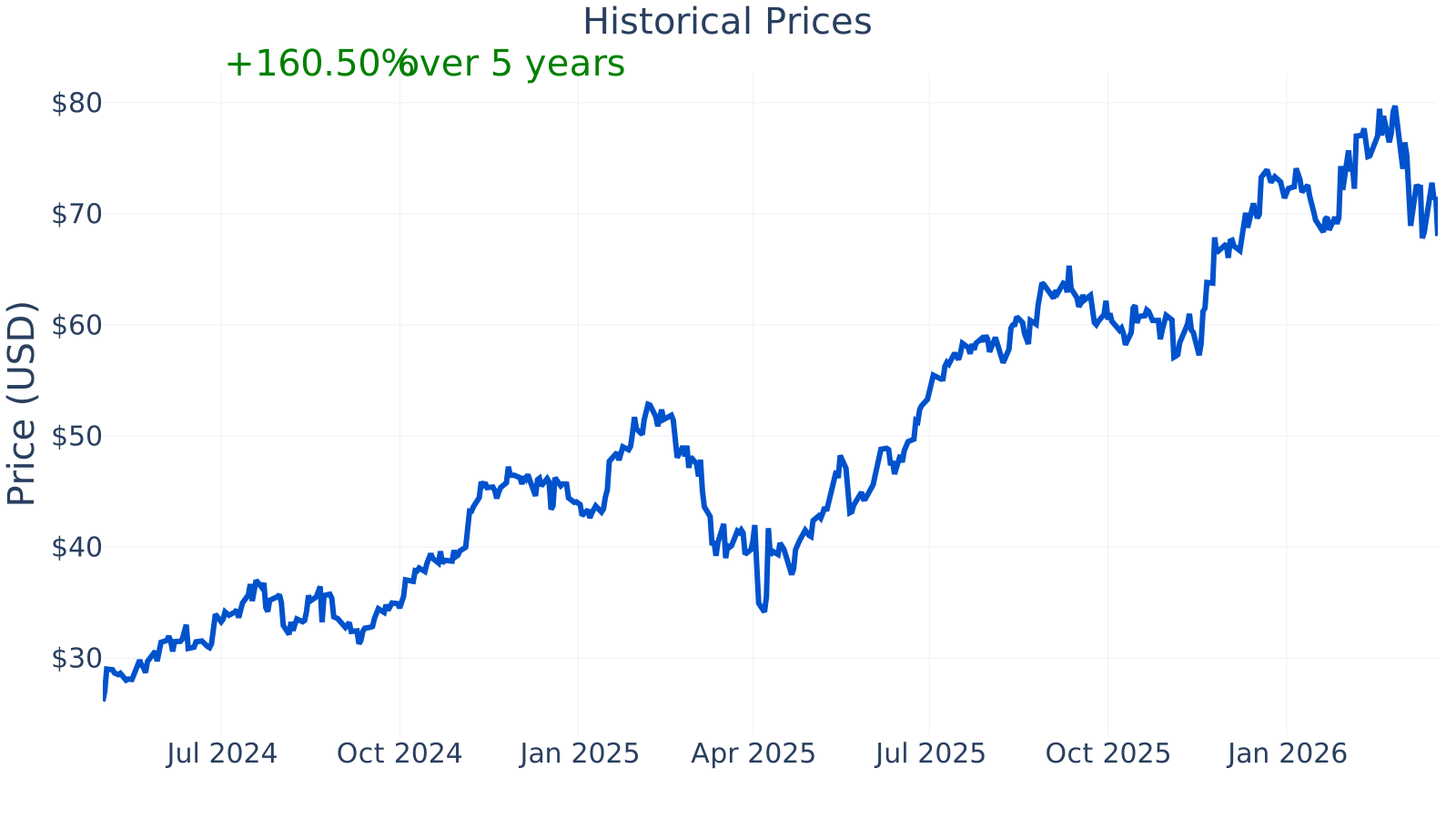
At the latest point shown, Viking’s market capitalization is about $30.3B. The company’s P/E ratio is ~26.5 versus an industry median of ~24.4, and its profit margin is ~17.7% versus an industry median of ~8.8%. Reported year-over-year revenue growth is ~27.8% versus an industry median of ~12%. Leverage stands out: debt-to-equity is ~512% compared with an industry median of ~94%. Trailing twelve-month free cash flow is about $1.53B (as displayed in the table).
Growth (medium)
Viking operates in leisure travel, where demand typically benefits from long-term trends such as consumers prioritizing experiences, growing interest in destination-based travel, and the continued normalization of international tourism. That said, travel is cyclical: growth can be strong in good economic conditions and can slow sharply when consumers cut discretionary spending.
Viking’s recent financial trajectory (rising revenue and improved profitability in the period shown) suggests the company has been expanding and/or improving yield (the effective price per guest) and efficiency. A practical way to think about future growth drivers is: higher occupancy, better pricing, new capacity coming online over time, and disciplined cost control—while keeping customer satisfaction high enough to maintain demand.
The year-over-year revenue growth rates shown remain positive and range from roughly 18% to 28% across the periods displayed, ending near 28%. Sustained growth at that level typically indicates strong demand and/or capacity expansion, though it is not guaranteed to continue at the same pace in a cyclical industry.
Free cash flow (a cash-based measure that can matter for debt repayment and fleet investment) trends upward in the periods shown—from about $1.00B to about $1.19B—and the latest table value shows about $1.53B on a trailing basis. In capital-intensive businesses like cruising, maintaining positive free cash flow can be important because ships require ongoing investment and the balance sheet is often leveraged.
Risks (high)
The cruise industry has several structural risks that tend to be more pronounced than in many other consumer businesses. Demand is discretionary and can fall quickly in recessions, when air travel is disrupted, or when consumers become more price-sensitive. In addition, operating costs can be volatile (for example, fuel and labor), and cruise operators must comply with extensive safety, environmental, and port-related regulations. Reputational risk also matters: service issues or operational disruptions can affect bookings and pricing power.
Viking’s financial risk profile is meaningfully influenced by leverage. Higher debt can amplify both outcomes: it may enhance returns in strong periods but can also increase vulnerability if demand weakens or costs rise, because interest and principal obligations remain.
Debt-to-equity ends around 512%, well above the industry median shown (roughly 143% at the same time). The earlier negative values on the chart typically occur when equity is negative or very small in accounting terms, which can happen after periods of losses or balance-sheet restructuring; that can make this ratio harder to interpret in earlier quarters. Even focusing on the latest figure, leverage is elevated versus peers, and that tends to increase sensitivity to downturns and to changes in interest rates or refinancing conditions.
Competitive dynamics are another risk. The cruise market includes several large global operators with significant scale, brand portfolios, and purchasing power, as well as niche operators focused on specific traveler segments. Viking’s competitive position is often associated with a differentiated brand and product focus, but it still competes for the same travel budget and faces similar macro and operating challenges as other cruise companies.
Profit margin improves markedly over the periods shown, rising from about 2.6% to about 17.7%, and finishes above the industry median displayed (about 7.3% at the end of the series). This suggests stronger recent profitability than the typical peer in the comparison set; however, margins in travel businesses can change quickly with pricing, occupancy, and cost swings.
Valuation
Valuation is often discussed using the price-to-earnings (P/E) ratio, which compares the stock price to earnings. For cyclical industries like cruising, a P/E ratio can look “low” near peak earnings and “high” when earnings are temporarily depressed, so it is usually best read alongside leverage, cash flow, and the stability of margins.
The P/E values shown are mostly in the high-20s range during the displayed dates (roughly 28–30 for the company), while the industry median ranges from about 18 to 29 over the same span. The latest metrics table shows a current P/E of about 26.5 versus an industry median of about 24.4. In practical terms, that places Viking near (and sometimes above) the peer-group middle depending on the date, suggesting the market is not pricing it as a deep outlier relative to the industry—despite the company’s stronger recent margin and revenue growth, and also despite its higher leverage.
Whether that valuation level is justified depends largely on durability: how resilient demand and pricing remain through weaker economic periods, and how effectively the company manages its balance sheet (especially given the elevated debt-to-equity level) while continuing to generate cash.
Conclusion
Viking Holdings Ltd is a consumer cyclical travel company with a cruise-centered model and a recent history (in the period shown) of strong revenue expansion, sharply improving profitability, and positive free cash flow. Those are constructive operating signals for a business that must cover substantial fixed costs.
At the same time, the company carries elevated leverage versus the industry median, and the cruise sector is exposed to demand cycles, cost volatility, and operational/regulatory risks. The valuation metrics shown place the company broadly in line with peers on earnings multiples while its margins and growth appear stronger than the median, which suggests the market is balancing improved performance against higher financial risk and the cyclicality of travel demand.
Sources:
- U.S. Securities and Exchange Commission (SEC) EDGAR — Viking Holdings Ltd filings (Annual Report on Form 10-K, Quarterly Reports on Form 10-Q, Current Reports on Form 8-K)
- Viking Holdings Ltd — Investor Relations materials and press releases (company-hosted)
- Wikipedia — “Viking Holdings” (basic company background)
This article is for informational purposes only and does not constitute financial advice. Some content is AI-generated. See Disclaimer


