Stock Analysis · Viking Holdings Ltd (VIK)
Overview
Viking Holdings Ltd (VIK) operates in the cruise and travel services space, with a brand positioned around “destination-focused” itineraries and an upscale onboard experience. The business earns money primarily by selling cruise itineraries (ticket revenue) and then adding onboard and related revenue streams tied to the guest experience.
In simple terms, Viking’s economics depend on (1) filling available capacity at healthy pricing and (2) managing large fixed costs (ships, crew, fuel, food, port fees) efficiently across sailings.
Public filings typically describe revenue as coming mainly from passenger ticket revenue and onboard/other revenue (such as excursions and onboard services). A precise, current percentage split by revenue line is not provided here.
Across the years shown, total revenue increased substantially from 2021 to 2024, while profitability fluctuated. Interest expense is a meaningful cost line, which matters because it can reduce the share of revenue that ultimately becomes net income, especially when borrowing costs are high.
Key Figures
| Metric | Value | Industry ⓘ |
|---|---|---|
| Date | Feb 07, 2026 | |
| Context | ||
| Sector | Consumer Cyclical | |
| Industry | Travel Services | |
| Market Cap ⓘ | $34.15B | |
| Beta ⓘ | N/A | |
| Fundamental | ||
| P/E Ratio ⓘ | 35.98 | 21.78 |
| Profit Margin ⓘ | 15.53% | 10.37% |
| Revenue Growth ⓘ | 19.10% | 10.60% |
| Debt to Equity ⓘ | 705.43% | 96.47% |
| PEG ⓘ | N/A | |
| Free Cash Flow ⓘ | $673.69M | |
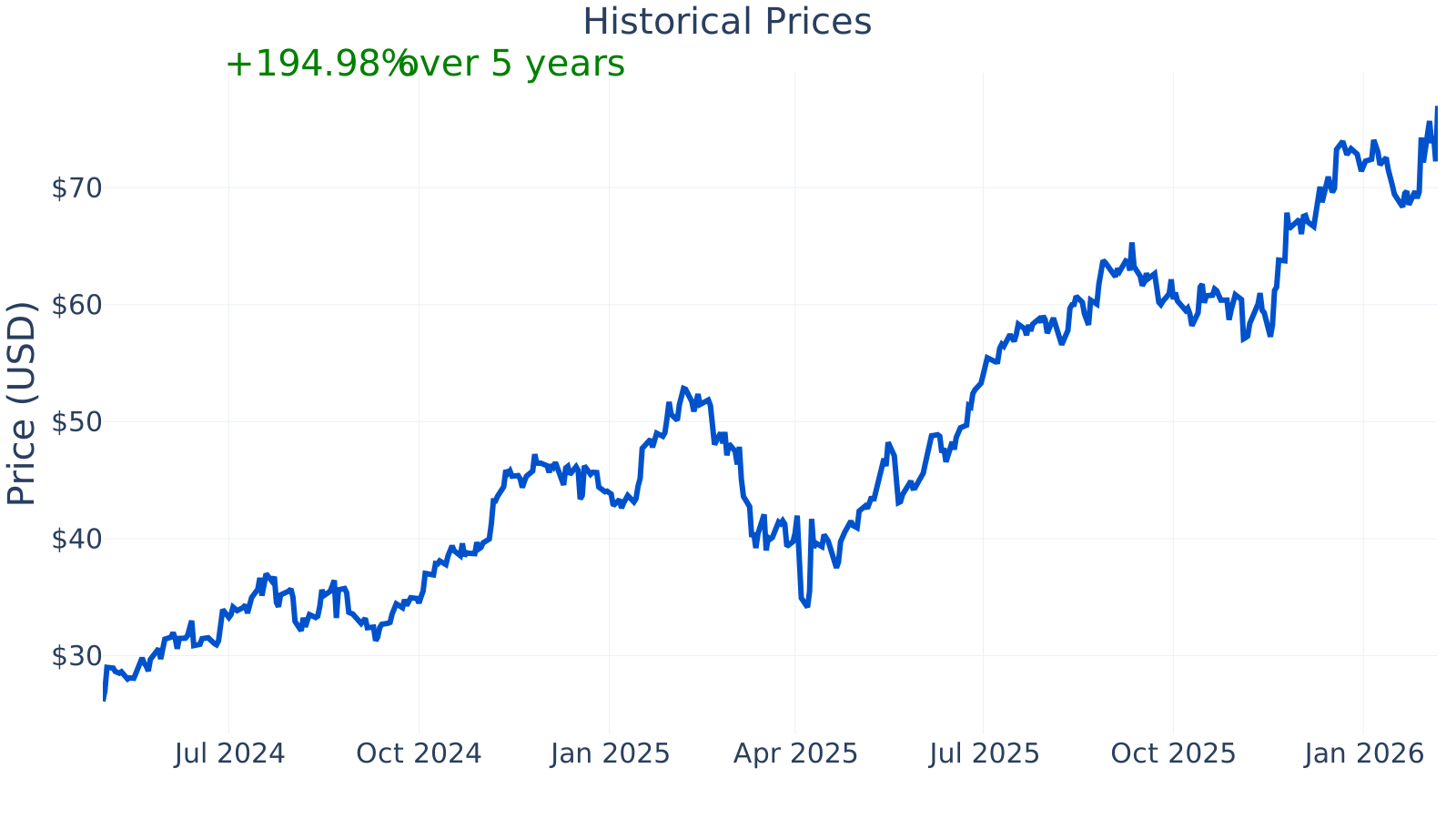
Viking’s market capitalization is about $34.2B. The company’s P/E ratio is ~36.0 versus an industry median around 21.8, indicating the stock trades at a higher earnings multiple than the typical peer in its listed industry set.
Recent profit margin is ~15.5% versus an industry median near 10.4%. Recent year-over-year revenue growth is ~19.1% compared with an industry median around 10.6%, suggesting the company has recently been expanding sales faster than the median peer while also posting stronger margins.
Debt-to-equity is ~705% versus an industry median near 96%, pointing to meaningfully higher financial leverage than the typical peer. Trailing twelve-month free cash flow is about $674M, which is an important indicator of how much cash the business generates after operating costs and capital spending.
Growth (Medium)
The cruise industry is generally driven by long-term travel demand, consumer discretionary spending, and demographic trends (including retirees and higher-income travelers who prioritize experiences). Over time, growth tends to come from a combination of higher capacity (more ships or higher utilization), pricing, and onboard spending. However, the sector is also cyclical: demand can weaken during recessions or periods of high inflation, and costs (notably fuel and labor) can swing.
Viking’s recent results point to a growth phase, with year-over-year revenue growth staying elevated in the periods shown.
The trajectory shown (roughly mid-to-high teens to mid-20s percentage growth across the plotted quarters) indicates strong recent top-line momentum. For a travel company, sustained growth at these levels usually requires both solid demand and effective capacity/pricing management.
Cash generation is another practical “reality check” for growth, because cruise businesses are capital-intensive.
The free cash flow values shown are positive (about $1.00B at 2024-12-31 and $1.19B at 2025-03-31), while the latest metric table also shows $674M (TTM) as a more recent snapshot. Positive free cash flow can support reinvestment, balance sheet flexibility, and resilience during demand slowdowns, but fluctuations are common in this industry due to seasonality, working capital swings, and timing of capital spending.
Potential catalysts for future growth in this type of business typically include higher occupancy, better pricing, improved onboard revenue, and cost normalization (including interest expense trends). The magnitude of the leverage shown in the risk section below makes interest rates and refinancing conditions particularly relevant.
Risks (High)
This article is for informational purposes only and does not constitute financial advice. Some content is AI-generated. See Disclaimer