Stock Analysis · Liberty Latin America Ltd (LILAK)
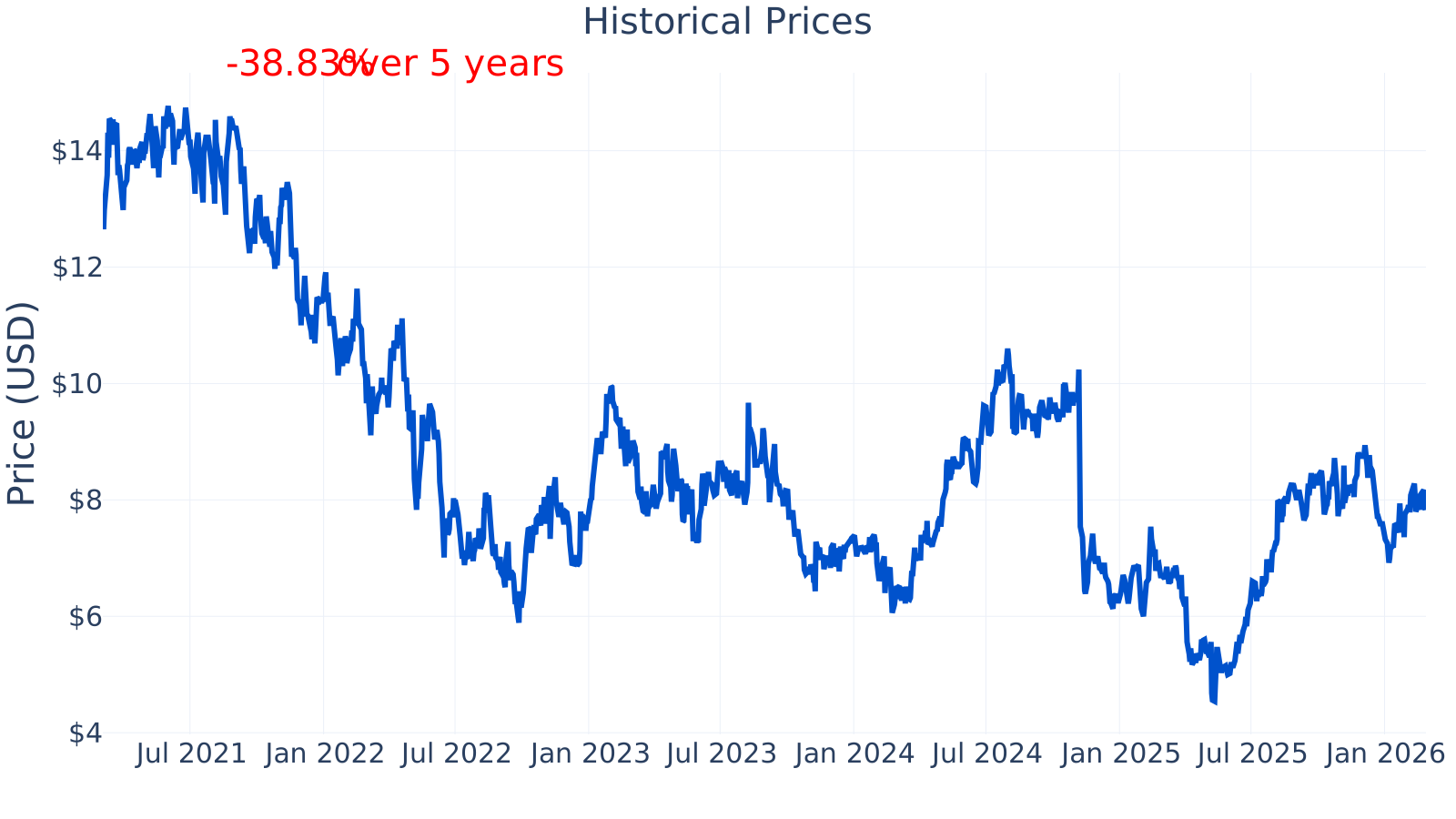
Overview
Liberty Latin America Ltd (LILAK) is a telecommunications operator focused on consumer and business connectivity services across parts of Latin America and the Caribbean. In plain terms, it builds and runs networks (mainly fixed broadband and cable infrastructure, and in some markets mobile services) and then sells recurring subscriptions to households and organizations.
Its business model is typically subscription-based, meaning a large share of revenue tends to come from monthly service fees rather than one-time sales. The company reports results by operating markets, and its services generally fall into familiar categories such as internet access, video/TV services, mobile, and business connectivity solutions.
Main revenue streams (typical telecom mix; exact percentages vary by market and period and are detailed in company filings):
- Broadband internet subscriptions (recurring monthly fees)
- Video / pay-TV services (subscription bundles in certain markets)
- Mobile services (in markets where the company operates mobile networks or mobile offerings)
- Business-to-business services (connectivity, managed services, and related enterprise products)
- Equipment and other (devices, installation, and miscellaneous items, usually a smaller portion)
Looking at the company’s overall profit-and-loss flow over time, total revenue has been in the mid-single-digit billions of dollars annually in recent years, while profitability has been heavily influenced by operating costs and especially financing costs (interest expense), which can be meaningful for leveraged telecom operators.
Across the years shown, revenue appears relatively steady overall, while interest expense remains large in absolute dollars. That dynamic helps explain why net income can stay negative even when operating income is positive in some years.
Key Figures
| Metric | Value | Industry ⓘ |
|---|---|---|
| Date | Mar 02, 2026 | |
| Context | ||
| Sector | Communication Services | |
| Industry | Telecom Services | |
| Market Cap ⓘ | $1.59B | |
| Beta ⓘ | 1.01 | |
| Fundamental | ||
| P/E Ratio ⓘ | N/A | 16.24 |
| Profit Margin ⓘ | -13.76% | 6.34% |
| Revenue Growth ⓘ | 1.70% | 2.05% |
| Debt to Equity ⓘ | 1659.72% | 119.24% |
| PEG ⓘ | 0.83 | |
| Free Cash Flow ⓘ | $408.02M | |
At the latest point shown, Liberty Latin America’s market capitalization is about $1.59B, and the stock’s beta is about 1.01 (roughly in line with broad market volatility). The company shows a negative profit margin of about -13.8%, compared with an industry median near +6.3%, indicating weaker bottom-line profitability than many peers. Year-over-year revenue growth is about +1.7% versus an industry median near +2.1%, suggesting growth is modest and close to sector norms. Debt-to-equity is shown at roughly 1,660% versus an industry median near 119%, highlighting substantially higher leverage than the typical company in the same broad industry grouping. Trailing twelve-month free cash flow is about $408M, which indicates the business is generating cash even while reported earnings are negative.
Growth (Low to Medium)
Telecom and broadband are generally considered mature industries. Demand for data connectivity tends to be resilient over time because households and businesses treat internet access as a staple service. However, mature industries often grow slowly, and competition plus ongoing network investment can limit how much of that demand turns into higher profits.
For Liberty Latin America, a key long-term question is whether it can expand high-value connectivity (for example, faster broadband tiers, better network reliability, and stronger business services) while controlling costs and keeping capital spending efficient. In many telecom models, the most durable growth tends to come less from rapid revenue expansion and more from improving customer mix, reducing churn, and increasing cash generation relative to investment needs.
The year-over-year revenue growth pattern shown is uneven: strong growth in 2021 fades substantially, with several periods of flat to negative growth through 2023–2025, and only small positive readings more recently. That profile points to a business that may be stabilizing rather than expanding rapidly.
Free cash flow over the trailing twelve months rises from roughly $176.5M (2021) to about $322.9M (2025 Q1), which is a constructive trend for a capital-intensive telecom operator. A potential catalyst over time would be the ability to sustain or grow free cash flow while also managing refinancing needs and network investment requirements.
Risks (High)
The most prominent risk area is financial leverage. Telecom networks require ongoing capital spending, and many operators use debt to fund buildouts and acquisitions. When leverage becomes very high, refinancing conditions and interest rates can have an outsized impact on shareholder outcomes, because more cash must go to lenders before it can benefit equity holders.
The debt-to-equity trend shown climbs materially over time, reaching roughly 1,660% at the latest point, far above the industry median (roughly 114% at the same time). Even allowing for accounting differences across companies, this level implies that changes in borrowing costs, covenant constraints, or access to capital markets could meaningfully affect flexibility.
Another key risk is profitability consistency. While telecom services can be sticky, margins can be pressured by competition, promotional pricing, content costs (where pay-TV is still relevant), operating expenses, and depreciation/amortization from large network asset bases. Currency movements and local economic conditions can also affect reported results for a company operating across multiple countries and territories.
Profit margin is frequently below zero in the periods shown, and the latest reading is about -13.8% versus an industry median near +5.1%. That gap suggests the company has had more difficulty translating revenue into bottom-line profit than many peers, which can be tied to cost structure, financing costs, non-cash charges, or market dynamics.
On competitive position, Liberty Latin America typically operates against a mix of:
- Local incumbent telecom operators (often with large fixed-line and/or mobile footprints)
- Other cable and broadband providers (including regional players)
- Mobile-focused competitors (in markets where mobile substitution pressures fixed services)
- Over-the-top streaming services (which can reduce the value of traditional pay-TV bundles)
Competitive advantages in telecom often come from network quality, coverage, customer service, bundled offerings, and scale in a given market. Because Liberty Latin America is a collection of market positions across different geographies, its strength is best judged market-by-market rather than as a single global leader. That structure can diversify exposure, but it can also make execution more complex.
Valuation
Valuation for telecom companies is often discussed using earnings-based metrics (like P/E), cash flow metrics, and leverage-aware approaches. For Liberty Latin America, earnings-based valuation can be harder to interpret when net income is negative or volatile, even if operating cash generation is positive.
The P/E series shown is intermittent (with many periods at 0, which often happens when earnings are negative or otherwise make P/E not meaningful). When a P/E is available in the history shown, it sometimes appears below the industry median (for example, in parts of 2023). Separately, the industry median P/E shown in the latest metrics is about 16.24, but the company’s own current P/E is not listed there—consistent with the challenge of using P/E when profitability is negative.
In this context, whether the stock price is “expensive” or “cheap” cannot be concluded from P/E alone. A more grounded interpretation is that the market is weighing (1) the company’s ability to keep producing free cash flow and (2) the balance-sheet risk implied by high leverage and ongoing interest costs, alongside (3) relatively modest revenue growth.
Conclusion
Liberty Latin America is a subscription-based connectivity business in a generally mature industry where demand is steady but growth is typically incremental. The company shows improving trailing free cash flow over the multi-year period shown, which is an important support for capital-intensive telecom operations.
At the same time, reported profitability is weak versus industry norms, and the leverage indicators are unusually high compared with the sector median. As a result, the long-term picture depends heavily on execution (operational stability, cost control, and customer performance) and on financial factors (refinancing conditions and interest burden). For readers evaluating the stock as a long-term holding, the defining trade-off is between steady-service characteristics and cash generation potential on one side, and elevated balance-sheet and profitability risk on the other.
Sources:
- SEC EDGAR — Liberty Latin America Ltd filings (Annual Report on Form 10-K, Quarterly Reports on Form 10-Q)
- Liberty Latin America — Investor Relations materials (company-hosted filings and releases)
- Wikipedia — “Liberty Latin America” (basic company background)
This article is for informational purposes only and does not constitute financial advice. Some content is AI-generated. See Disclaimer


