Stock Analysis · Alpha and Omega Semiconductor Ltd (AOSL)
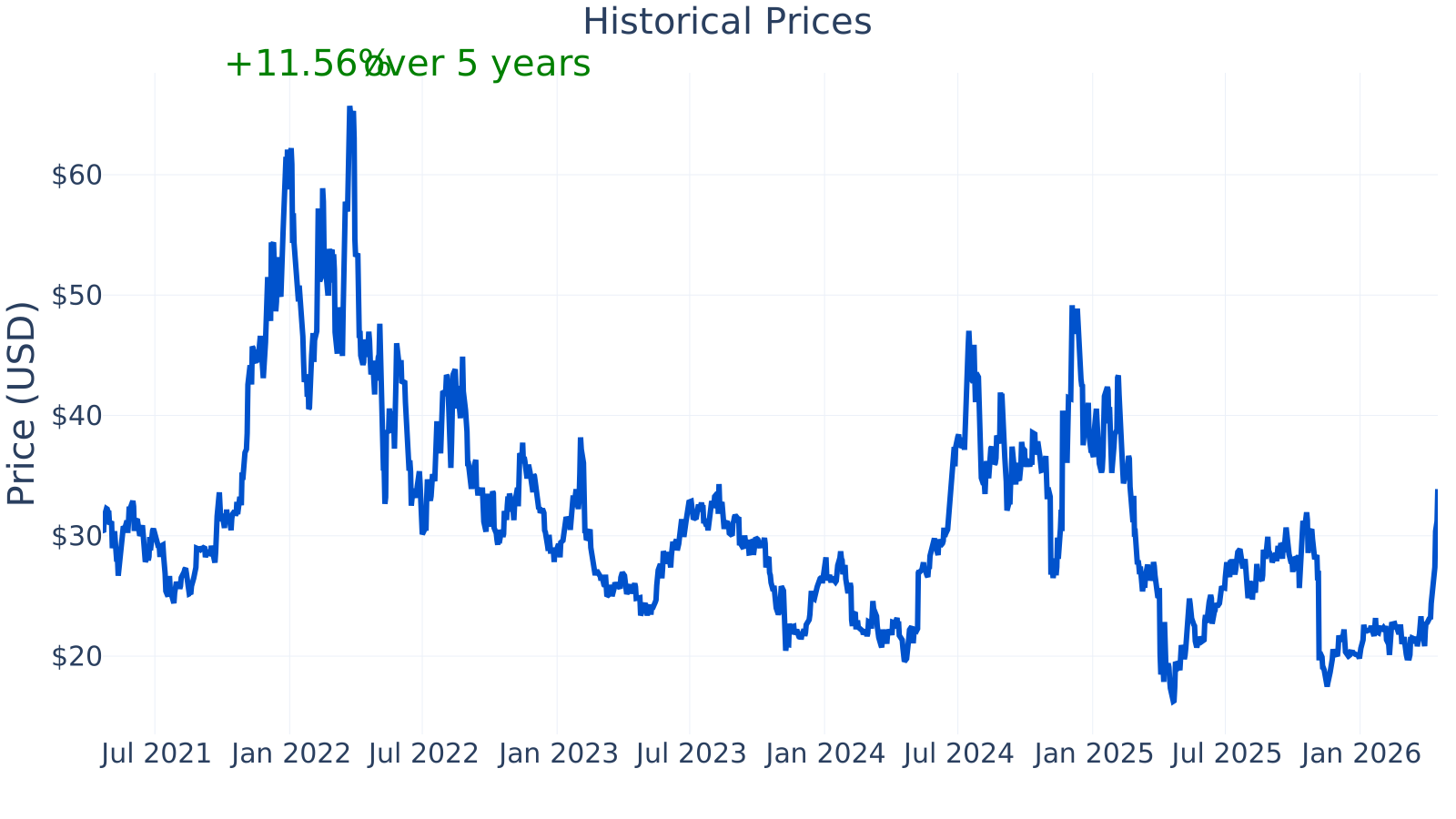
Overview
Alpha and Omega Semiconductor Ltd (AOSL) is a semiconductor company focused on power management. In simple terms, it designs and sells components that help control how electricity is converted, switched, and delivered inside electronic devices. These parts are used in everyday equipment such as consumer electronics, computing and data center hardware, industrial systems, and vehicles (including electrified power systems where efficient energy use matters).
Because AOSL operates in semiconductors, results tend to move with “cycles” in electronics demand: when customers build more devices, chip orders rise; when customers reduce inventory, orders can fall for multiple quarters.
Public filings commonly describe revenue mainly by product categories and end markets (rather than a simple subscription-style breakdown). AOSL’s revenue is primarily generated from selling power semiconductors, typically including:
- Power MOSFETs (a core switching component used across many electronics)
- Power ICs (integrated circuits that manage power delivery and regulation)
- Other power discrete devices (supporting components used in power conversion)
Exact percentage splits by product/end market can vary by period and are best taken from the most recent annual report (Form 10-K) segment and customer concentration disclosures.
Across the periods shown, revenue has been broadly in the same range, while profitability has swung significantly. Operating expenses (notably R&D and selling/general/administrative costs) remain substantial, so small changes in gross profit can meaningfully affect operating income and net income.
Key Figures
| Metric | Value | Industry ⓘ |
|---|---|---|
| Date | Apr 20, 2026 | |
| Context | ||
| Sector | Technology | |
| Industry | Semiconductors | |
| Market Cap ⓘ | $1.01B | |
| Beta ⓘ | 1.94 | |
| Fundamental | ||
| P/E Ratio ⓘ | N/A | 56.07 |
| Profit Margin ⓘ | -15.06% | 9.11% |
| Revenue Growth ⓘ | -6.30% | 15.60% |
| Debt to Equity ⓘ | 3.82% | 23.21% |
| PEG ⓘ | -8.49 | |
| Free Cash Flow ⓘ | -$41.35M | |
AOSL’s market capitalization is about $1.01B, placing it in the small-to-mid size range for public semiconductor companies. The stock’s beta of ~1.94 indicates it has historically moved much more than the broader market, which is common for smaller, cycle-exposed chip businesses.
On profitability and growth, the latest metrics show negative profit margin (about -15.1%) versus an industry median of about +9.1%, and year-over-year revenue growth of about -6.3% versus an industry median of about +15.6%. AOSL’s debt-to-equity is about 3.8%, well below the industry median (about 23.2%), indicating relatively low balance-sheet leverage. The company’s free cash flow (TTM) is about -$41.3M, which means cash generation has been under pressure recently.
Growth (Medium)
The company operates in the semiconductor industry, and more specifically in power semiconductors. Long-term demand drivers for power management chips are closely tied to broad trends such as increasing electronic content in devices, efficiency requirements, data center power needs, and electrification. These are structurally supportive themes, but they do not eliminate the near-term cyclicality that can affect revenue, utilization, and margins.
The year-over-year revenue growth pattern shows how cyclical demand has been: strong growth earlier in the period was followed by a notable downturn and then an uneven recovery. The most recent reading is around -6.3% year over year, which suggests the company is not currently growing in line with the typical semiconductor peer set (industry median shown around +15.6% for comparison).
Cash generation has also been volatile. Free cash flow was positive earlier in the period, turned meaningfully negative, and then improved toward breakeven before weakening again (latest trailing figure approximately -$41.3M). For long-term business momentum, sustained positive free cash flow often matters because it can fund R&D and capacity-related needs without relying as much on external financing.
Potential catalysts (in general, based on how this industry works) include normalization of customer inventories, improved pricing or product mix in higher-value power solutions, and a rebound in end-market demand. Whether these materialize can usually be tracked in quarterly filings through revenue trends, margin direction, and management discussion of backlog and customer demand.
Risks (High)
AOSL faces several risks that are typical for a smaller semiconductor supplier. The most important is profitability risk: the company has recently been operating with negative margins, which can persist if demand is soft, pricing is competitive, or costs remain elevated relative to revenue.
The profit margin trend shows a clear deterioration from strongly positive levels earlier in the period to consistent losses more recently. The latest profit margin is about -15.1%, compared with an industry median around +9.1%. This gap suggests either weaker pricing power, less favorable product mix, underutilization, higher costs, or a combination of factors. A key long-term question is whether margins can return to positive territory through cycle recovery and execution.
Another major risk is industry cyclicality and customer concentration dynamics. In semiconductors, customers can rapidly shift from ordering aggressively to reducing orders while working through inventory, and smaller suppliers can feel these swings strongly. Competitive pressure can also be intense, especially in more “standardized” product areas where customers can qualify multiple sources.
On balance-sheet risk, leverage appears relatively low. Debt-to-equity has fallen substantially over time, reaching roughly 3.8% most recently, well below the industry median (about 20.7%–23.2% depending on the period shown). Lower leverage can reduce financial stress during downcycles, although it does not by itself solve operating losses or negative cash flow.
Competitive positioning is another consideration. AOSL participates in power semiconductors alongside much larger, diversified competitors with broad product catalogs and deep customer relationships. Major competitors in power semiconductors commonly include:
- Infineon Technologies
- onsemi
- STMicroelectronics
- Vishay Intertechnology
- NXP Semiconductors (power management in certain categories)
- Texas Instruments and Analog Devices (power management ICs, among other analog products)
AOSL’s potential advantages typically depend on product performance, cost structure, and customer-specific design wins. However, based on scale alone, it is not the category leader versus the largest global suppliers, which can matter during pricing pressure or when customers prefer fewer, broader vendors.
Valuation
Valuation for semiconductor companies is often discussed using earnings-based multiples such as the P/E ratio, but this becomes less informative when earnings are very low or negative. In those cases, P/E may not be meaningful for some periods and can appear as zero or not applicable in simplified charts.
Historically, AOSL’s P/E moved from more typical levels (teens to 20s in parts of 2021) to very low levels in 2022, and then became not meaningful in later periods (consistent with the shift toward losses reflected in profit margin). Meanwhile, the industry median P/E shown is often materially higher in many periods, which highlights a key point: comparing P/E ratios is only useful when profits are stable and positive. For AOSL, the central valuation debate tends to depend less on today’s earnings multiple and more on whether revenue growth and margins normalize over a full cycle.
With that context, whether the current stock price looks “expensive” or “cheap” cannot be determined from P/E alone. A more grounded approach is to link valuation to operating realities: if margins remain negative and free cash flow stays weak, valuation tends to be harder to support; if profitability improves and cash generation turns sustainably positive, valuation measures often become more interpretable.
Conclusion
AOSL is a power semiconductor company positioned in an industry supported by long-term electrification and efficiency trends, but its financial profile in the most recent period shows pressure on revenue growth, negative profit margins, and negative trailing free cash flow. At the same time, the balance sheet appears conservatively leveraged relative to many peers, which can be an important stabilizer in a cyclical downturn.
From a long-term ownership perspective, the most decisive factors to monitor are whether the business can restore consistent profitability and convert sales into durable free cash flow through the cycle, while sustaining product competitiveness against much larger semiconductor peers.
Sources:
- SEC EDGAR — Alpha and Omega Semiconductor Ltd filings (Form 10-K, Form 10-Q)
- Alpha and Omega Semiconductor — Investor Relations (press releases and investor materials)
- Wikipedia — “Alpha and Omega Semiconductor” (basic company background)
This article is for informational purposes only and does not constitute financial advice. Some content is AI-generated. See Disclaimer


