Stock Analysis · Liberty Global PLC (LBTYA)
Overview
Liberty Global PLC is a telecommunications company focused on building and operating fixed networks (mainly broadband internet) and related services. Historically it operated cable and broadband businesses across multiple European countries, but in recent years it has reshaped its footprint through sales, joint ventures, and investments. Today, the company’s profile is more of a mix between (1) operating telecom assets in select markets and (2) holding stakes in telecom ventures and other strategic investments, with results that can be influenced by transactions, ownership changes, and accounting items linked to these investments.
In practical terms, the underlying business is about providing connectivity (high-speed internet), sometimes bundled with video/TV and fixed-line voice, to households and businesses. These services tend to be subscription-based, meaning customers pay monthly fees, which can support recurring revenue—although competition and customer churn can affect stability.
Liberty Global reports revenue by business/geographic segments in its annual report, and the mix can change over time as the company buys/sells assets or reorganizes holdings. In general, the largest recurring revenue sources typically come from:
- Broadband internet subscriptions (usually the largest component in cable/fixed-network operators)
- Video/TV services (often declining structurally over time versus broadband)
- Fixed-line voice (generally a smaller and declining portion)
- Mobile-related services (where offered directly or through partnerships)
- Business-to-business connectivity and related services (for enterprises and small businesses)
The company’s reported totals can also be meaningfully affected by non-operating items (for example, gains/losses tied to investments, changes in ownership stakes, restructuring, or impairment charges), which may make headline profit figures less intuitive than they are for a more “plain vanilla” telecom operator.
Across the years shown, total revenue is in the mid-single-digit billions of dollars, while operating income and net income swing sharply between positive and negative. This pattern is consistent with a company where results can be heavily influenced by one-time items and investment-related impacts, rather than only the day-to-day performance of selling broadband and connectivity.
Key Figures
| Metric | Value | Industry ⓘ |
|---|---|---|
| Date | Mar 02, 2026 | |
| Context | ||
| Sector | Communication Services | |
| Industry | Telecom Services | |
| Market Cap ⓘ | $4.27B | |
| Beta ⓘ | 0.84 | |
| Fundamental | ||
| P/E Ratio ⓘ | N/A | 16.24 |
| Profit Margin ⓘ | -146.32% | 6.34% |
| Revenue Growth ⓘ | 9.60% | 2.05% |
| Debt to Equity ⓘ | 104.39% | 119.24% |
| PEG ⓘ | 1.61 | |
| Free Cash Flow ⓘ | $782.50M | |
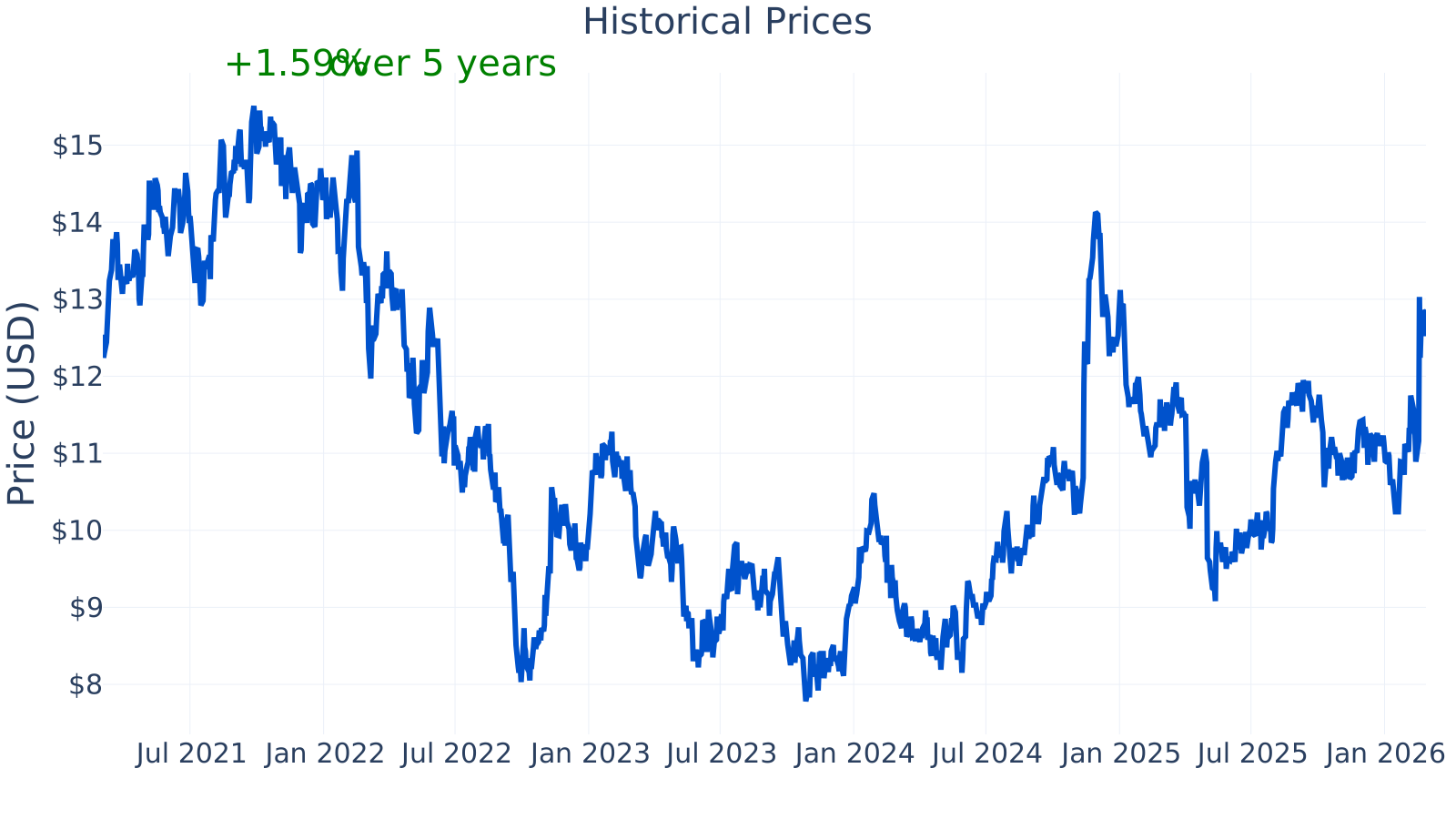
Liberty Global’s market capitalization is about $4.27B, and the stock’s beta of ~0.84 suggests price moves have been somewhat less volatile than the broader market on average. The latest profit margin is -146%, well below the industry median of about 6%, which highlights how reported earnings have recently been weighed down by significant charges or losses. By contrast, the latest year-over-year revenue growth is ~9.6% versus an industry median near 2.1%, indicating faster top-line expansion in the most recent period shown. Debt-to-equity is ~104%, slightly below the industry median of about 119%, reflecting a capital structure that is leveraged but not unusual for telecom. Trailing twelve-month free cash flow is about $783M, which matters because telecom networks require ongoing investment, and cash generation can be more informative than net income in some periods.
Growth (Medium)
The company operates in the telecom and broadband industry, where demand for data connectivity has been supported by long-term trends such as streaming, remote work, cloud services, and connected devices. That said, in many developed markets broadband is mature: growth often comes from taking share, upgrading customers to faster tiers, improving pricing, expanding into adjacent services (for example, mobile bundles), or network expansion in underpenetrated areas.
Liberty Global’s strategy in recent years has emphasized portfolio reshaping (including joint ventures and asset sales) and focusing capital on networks and markets where it sees stronger returns. For long-term business momentum, the most important operational drivers tend to be broadband customer trends, pricing discipline, and network quality (for example, fiber upgrades or next-generation cable technology).
Revenue growth has been volatile across the timeline shown, swinging from steep declines in several periods to positive growth more recently, including a very large spike in the latest quarter shown. When revenue growth moves this sharply, it can reflect more than just “more customers” or “higher prices”—it may also reflect changes in the company’s structure, consolidation of entities, or other reporting effects. For readers, this makes it important to separate underlying operating momentum from transaction-driven changes.
Free cash flow has trended down from about $3.15B (2021) to about $0.97B (2025 period shown), with the latest trailing figure around $783M. For a network operator, this trend can matter because cash flow supports network investment, debt service, and flexibility for corporate actions. A lower run-rate can reduce room for error if competitive intensity rises or if capital spending needs increase.
Potential catalysts over time typically relate to (1) operational execution in core markets (customer growth, churn, pricing), (2) the economic returns on network upgrades, and (3) outcomes from portfolio actions (changes in stakes, mergers/joint ventures, and simplification of the structure). Whether these catalysts translate into durable improvement depends on competitive dynamics and the cost of maintaining and upgrading the network.
Risks (High)
Telecom is capital-intensive and highly competitive. Liberty Global faces ongoing pressure to invest in its network while also competing with other fixed-line providers (including fiber) and, in some cases, wireless alternatives. Competitive offers can lead to promotional pricing, higher churn, or slower customer additions, especially in mature markets.
A major risk for readers is that reported profitability can be difficult to interpret because it may include large non-cash or one-time impacts (for example, impairments, remeasurement of investments, restructuring, or transaction-related items). This can create large swings in net income that do not necessarily reflect the strength or weakness of the core broadband business in a given year.
Debt-to-equity is about 104% in the latest period shown, below the industry median near 114%, but still indicative of meaningful leverage. Leverage can amplify outcomes in both directions: it can help enhance returns when operations are stable, but it can also increase vulnerability if cash flow weakens, refinancing becomes more expensive, or interest rates remain elevated for longer.
Profit margins have been extremely volatile, including deep negatives in the most recent period shown (about -146%) while the industry median remains modestly positive (around 5%). This reinforces that earnings-based comparisons can be misleading without context about unusual items. It also signals that headline profitability has not been consistently stable.
Competitive advantages in this industry often come from owning high-quality last-mile infrastructure, having strong local brand recognition, achieving scale efficiencies, and bundling services (internet + mobile + TV). Liberty Global’s advantages, where present, tend to be local-market network positions and the ability to upgrade infrastructure over time. However, leadership is typically market-by-market rather than global, and the company faces strong competitors depending on the country and service (incumbent telecom operators, alternative fiber providers, and sometimes fixed-wireless offerings).
Because Liberty Global’s footprint and structure can change through transactions and joint ventures, an additional risk is complexity: ownership stakes, governance, and accounting treatment can make results less straightforward and can introduce uncertainty around how much of a partner’s performance flows through to Liberty Global’s financial statements.
Valuation
Traditional valuation measures that rely on stable earnings (like the price-to-earnings ratio) can be less informative when earnings are volatile or negative. Liberty Global’s P/E has frequently been shown as 0 across several periods, which generally happens when earnings are negative or when the ratio is not meaningful for that time. When the P/E does appear, it has been far below the telecom industry median in the periods shown, but that gap may reflect distorted or inconsistent earnings rather than a straightforward “cheaper than peers” signal.
The chart highlights that the industry median P/E has generally been in the low-to-mid teens across the timeline, while Liberty Global’s P/E is often not meaningful and occasionally shows very low values in the periods where it can be calculated. In situations like this, valuation discussions often lean more on cash flow generation, balance sheet leverage, and the sustainability of the underlying operating business rather than on net income multiples alone.
With a market capitalization around $4.27B and trailing free cash flow around $783M, the relationship between enterprise value (which would also include net debt) and cash flow becomes particularly important for context. However, without laying out the full enterprise value and net debt picture inside this article, the key takeaway is that cash flow and leverage are central to interpreting how demanding (or undemanding) the market’s pricing may be.
Conclusion
Liberty Global operates in a sector with ongoing demand for connectivity, where network quality and execution can support recurring subscription revenue. At the same time, the company’s reported results show significant volatility in profitability, and its business profile is influenced by portfolio actions and investment-related effects that can make headline earnings less straightforward to interpret.
The most grounded long-term discussion points are the company’s ability to (1) maintain and grow broadband-led revenue in competitive markets, (2) convert that revenue into durable free cash flow after ongoing network investment, and (3) manage leverage in a capital-intensive industry. The combination of volatile profit margins, meaningful debt, and structural complexity increases the importance of focusing on underlying operating performance and cash flow resilience rather than relying on a single valuation metric.
Sources:
- SEC EDGAR — Liberty Global plc Form 10-K (Annual Report)
- SEC EDGAR — Liberty Global plc Form 10-Q (Quarterly Reports)
- Liberty Global — Investor Relations materials (company-hosted filings and presentations)
- Wikipedia — “Liberty Global” (basic company background; non-financial context)
This article is for informational purposes only and does not constitute financial advice. Some content is AI-generated. See Disclaimer