Stock Analysis · Kodiak AI Inc (KDK)
Overview
Kodiak AI Inc (KDK) is a technology company listed in the Software - Infrastructure industry. Based on its public financial statements, it operates with a business model that is still in a relatively early or scaling stage: revenue is present, but the company currently spends more on operating costs (notably research and development) than it brings in from sales.
From the company’s reported income statement structure, the main revenue appears to come from a single primary stream rather than multiple diversified business lines. Public filings are typically the place where a company breaks revenue into products, services, and/or customer categories; without that breakdown included here, the most reliable conclusion is that revenue concentration is likely higher than for mature, diversified software peers.
What stands out operationally is the high ongoing investment level. In 2024, the company reported about $14.9M of total revenue and about $43.4M in research and development expense, alongside roughly $21.0M in selling, general, and administrative costs. That pattern is common for companies prioritizing product development and market expansion, but it also means results depend heavily on whether that spending eventually converts into sustainable revenue growth and improved margins.
Across 2023 to 2024, total revenue decreased (about $16.9M to $14.9M), while operating expenses increased (about $70.8M to $76.7M). Net loss also widened (about -$56.9M to -$69.5M). Interest expense remained meaningful (roughly $5.4M in 2023 and $5.0M in 2024), which can matter when a company is not yet profitable.
Key Figures
| Metric | Value | Industry ⓘ |
|---|---|---|
| Date | Feb 27, 2026 | |
| Context | ||
| Sector | Technology | |
| Industry | Software - Infrastructure | |
| Market Cap ⓘ | $1.50B | |
| Beta ⓘ | -0.40 | |
| Fundamental | ||
| P/E Ratio ⓘ | N/A | 24.87 |
| Profit Margin ⓘ | N/A | 6.79% |
| Revenue Growth ⓘ | 92.50% | 15.30% |
| Debt to Equity ⓘ | 1076.75% | 26.59% |
| PEG ⓘ | N/A | |
| Free Cash Flow ⓘ | -$122.34M | |
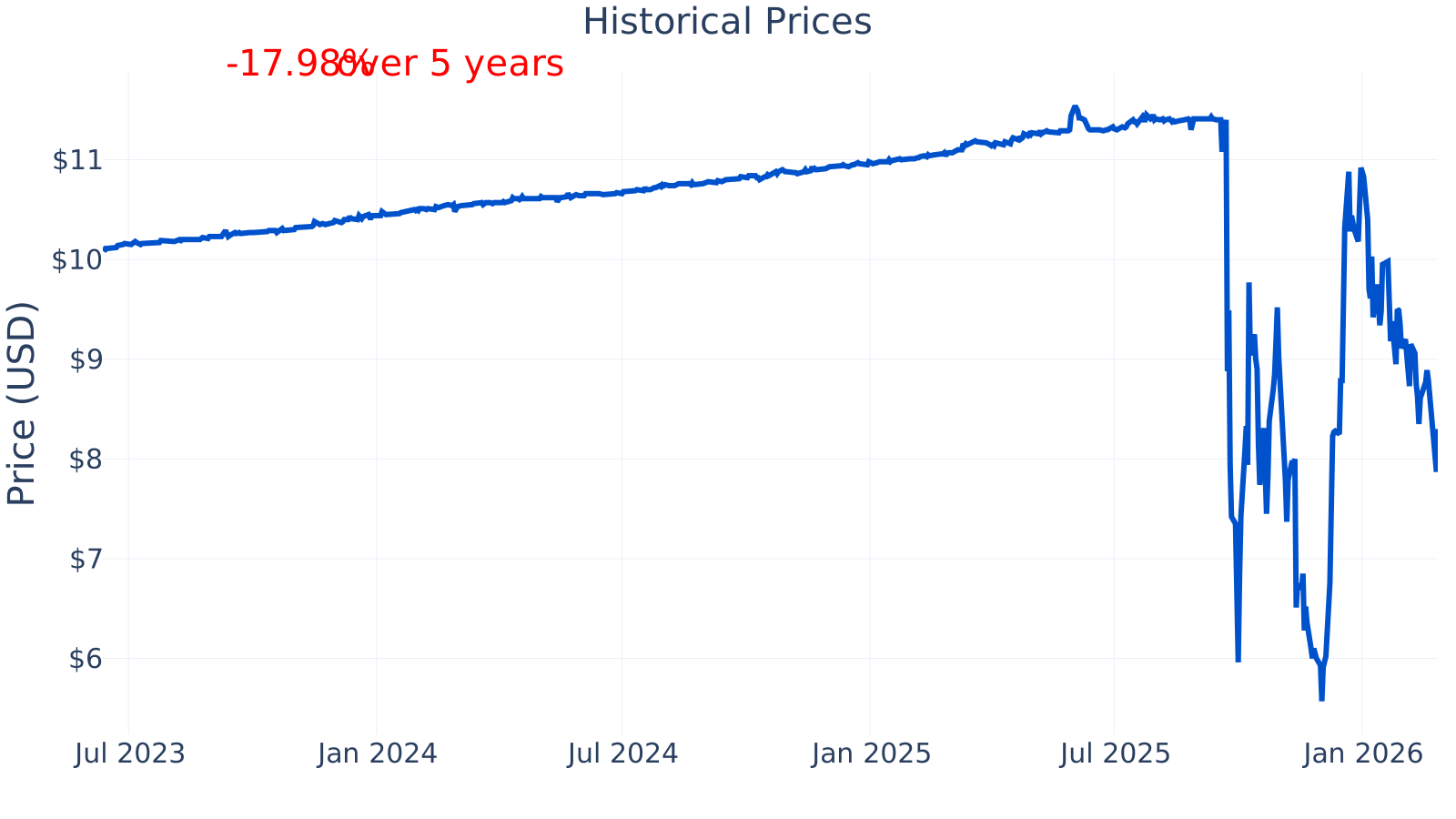
Kodiak AI’s latest market capitalization is about $1.50B. The company’s reported year-over-year revenue growth (latest shown) is 92.5%, which is well above the industry median of 15.3%, but the company’s profitability profile differs sharply from typical peers: profit margin is shown at 0% in the latest summary table (while the industry median is about 6.8%), and more detailed quarterly figures show deeply negative margins. Leverage is also a key theme: the latest debt-to-equity is about 1,076.8% versus an industry median near 26.6%. Free cash flow over the trailing period is negative (about -$122.3M), which implies the business has been consuming cash rather than generating it.
Growth (Medium)
The company operates in the software infrastructure space, a broad category that can benefit from long-term tailwinds like cloud adoption, increasing data volumes, security needs, and modernization of enterprise systems. In general, companies in this area can scale efficiently once products mature, because software revenue can grow faster than costs—but only if customer adoption and retention strengthen over time.
In the near term, Kodiak AI’s growth picture looks mixed. The latest year-over-year revenue growth metric in the summary is strong, but quarterly growth has been volatile, including a period of negative growth. That combination can happen when revenue is concentrated in a smaller number of customers or contracts, or when timing of deployments and renewals affects quarterly comparisons.
The year-over-year revenue growth rate swings materially across the periods shown (from very high growth to modest growth, then a sharp decline). For long-term business building, a key question is whether revenue becomes more consistent over time, with less dependence on a small number of wins or timing effects.
Free cash flow remains negative in the periods shown, which is consistent with the company’s high operating cost base and negative earnings. For a growth-oriented software company, improving free cash flow is often tied to a combination of higher gross profit, better operating leverage, and tighter working capital management. Until that trajectory improves, growth may require continued access to financing.
Risks (High)
This article is for informational purposes only and does not constitute financial advice. Some content is AI-generated. See Disclaimer